Apex vs Pent Roof Sheds: Which Should You Choose?
Compare apex and pent roof sheds on headroom, drainage, positioning, cost, and UK planning height. A clear, practical guide to picking the right shed roof type.
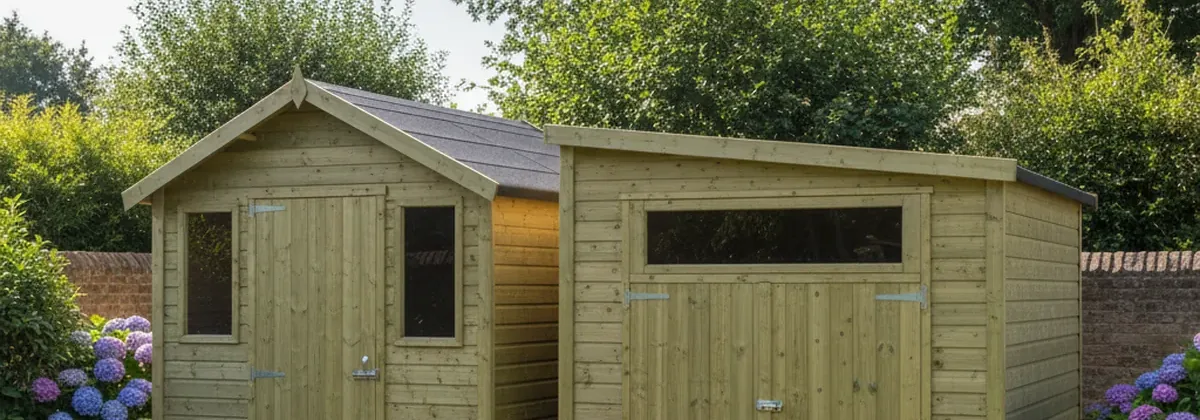
The roof is one of the first decisions you make when planning a garden shed, and it shapes far more than the look. Your choice between an apex and a pent roof affects headroom, drainage, where you can put the shed, and even whether you need planning permission. This guide breaks down both options so you can choose with confidence.
Choose an apex shed for maximum headroom and a classic look in an open spot. Choose a pent shed for a low profile that tucks neatly against a wall or fence and stays under tight height limits near a boundary.
How Each Roof Is Built and Looks
An apex shed has the roof shape most people picture when they think of a shed: a symmetrical A-frame. Two roof slopes rise from the side walls and meet at a central ridge running along the length of the building. The triangular gable ends sit above the front and back walls, and the door is usually set into one of these gable ends. The result is balanced, traditional, and instantly recognisable.
A pent shed takes a different approach. It has a single flat plane of roof, a mono-pitch, that slopes gently from a higher edge down to a lower edge. There is no ridge and no second slope. The look is cleaner and more contemporary, closer to a lean-to or a modern garden room, and the door typically sits in the tall front wall under the high edge of the slope.
In construction terms, the apex roof needs a ridge board, two sets of rafters meeting at the top, and roofing felt or shingles laid over both pitches. The pent roof is simpler: joists run from the high wall to the low wall in one direction, carrying a single deck and a single run of covering. Both are well within the reach of a competent DIY builder, but the pent has fewer parts to cut and align.
Headroom and Internal Space
This is where the two roofs differ most in daily use. The apex roof creates a tall peak down the centre of the shed. That central ridge gives generous standing height in the middle, which is excellent if you want to walk around comfortably, hang tools high on the gable walls, or fit overhead storage in the roof void. The trade off is that the headroom falls away towards the side walls, so the very edges of the floor are less usable for tall items.
The pent roof concentrates all of its height at the front. Standing just inside the door you have plenty of room, but the ceiling slopes down towards the back, so headroom tapers as you move deeper into the shed. This suits a workbench or shelving placed along the high front wall, with lower storage tucked under the slope at the back. For a small storage shed this is rarely a problem, but for a workshop where you move around a lot the apex usually feels more open.
With a pent shed, put the workbench and anything you stand at against the high wall, and reserve the low back wall for boxes and seasonal storage. With an apex, use the gable walls for tall shelving and the centre for clear walking space.
Rainwater Runoff and Guttering
Roof shape decides where the rain goes, and that matters in the UK. An apex roof sheds water to both sides, so if you want to collect rainwater or keep runoff off a path you need guttering and a downpipe on each side, or at least on the side that faces a problem area. Water is split evenly between the two pitches, so each gutter handles roughly half the flow.
A pent roof sends all of its water to a single low edge. That makes guttering simple: one gutter and one downpipe along the back, ideally feeding a water butt. Because the whole roof drains in one direction, you can position the shed so the runoff falls exactly where you want it, away from the door and away from neighbouring boundaries. Just make sure the low edge is not draining straight onto a fence or a neighbour's land.
Rainwater must not discharge onto adjoining property. With a pent shed placed near a boundary, point the low draining edge into your own garden, not over the fence, and fit a gutter to control where the water lands.
Positioning in the Garden
The pent shed is the natural choice when you want to use a boundary. Set the high side against a fence or wall and the roof slopes away from the boundary, keeping water and overhanging eaves on your side. The flat single slope means there is no ridge peaking above the fence line, so the shed sits discreetly along the edge of the garden and frees up the open middle of your plot.
The apex shed is happiest free-standing or where it has breathing room on both sides. Because its roof drains and overhangs to both edges, it ideally needs a little clearance left and right for the eaves and for maintenance access. Placed centrally or at the end of a lawn it reads as a proper little building, which is part of its appeal for garden offices and summerhouses.
If you are still working out where the shed will go and how big it should be, our guide on choosing the right shed size covers access, clearance, and boundary distances in detail.
Height and Planning Implications
In the UK most garden sheds are built under permitted development, which means you do not normally need a planning application. But there are height limits, and roof shape is central to whether you meet them.
The key rule is that an outbuilding within 2 metres of a boundary must be no more than 2.5 metres in total height. Beyond that 2 metre zone the limits are more generous: up to 4 metres for a dual pitched (apex) roof and up to 3 metres for any other roof, including pent.
Here is why this favours the pent near a boundary. For the same useful wall height, an apex roof rises further because of its central ridge, while a pent roof keeps a lower overall profile. So if your only sensible spot is tight against a fence, a pent shed makes it much easier to stay under the critical 2.5 metre limit and remain inside permitted development. An apex of similar internal height may push over 2.5 metres and force you either to move it away from the boundary or to apply for permission.
Permitted development rules differ for listed buildings, conservation areas, and designated land. For the full picture before you build, read our guide to shed planning permission in the UK and confirm with your local planning authority.
Cost and Complexity
A pent roof is generally the cheaper and simpler build. It uses a single run of joists, one flat deck, and one sheet of covering, with fewer cuts and no ridge to assemble. For a self builder that means less timber, fewer felt overlaps to seal, and a quicker afternoon on the roof.
An apex roof costs a little more. You are buying extra rafters, a ridge board, and enough felt or shingles to cover two pitches, and there is more cutting and fitting to get the two slopes meeting cleanly at the ridge. For a typical garden shed the price difference is modest, often a small percentage of the total, but it is real and worth factoring in.
Both roofs last well if built and felted properly. Whichever you choose, the foundation underneath matters just as much, so it is worth reading our guide on how to build a shed foundation before you start.
Side by Side Comparison
The table below summarises how apex and pent roofs compare across the factors that matter most when you are choosing.
| Feature | Apex Roof | Pent Roof |
|---|---|---|
| Roof shape | Symmetrical A-frame with central ridge | Single flat mono-pitch slope |
| Headroom | Tallest down the centre, great for standing | Tallest at the front, tapers to the back |
| Overhead storage | Good, useful roof void | Limited |
| Drainage | Runs off to both sides | Runs off to one low edge |
| Guttering | Often needs two gutters | One gutter and downpipe |
| Best position | Free-standing or open spot | Against a wall or fence |
| Profile near boundary | Taller, harder to keep under 2.5m | Lower, easier to stay under 2.5m |
| Build complexity | Moderate, ridge and two pitches | Simpler, single plane |
| Cost | Slightly higher | Slightly lower |
| Look | Traditional, classic shed | Modern, lean-to style |
Which Should You Choose?
Both roofs are good choices, so the right answer depends on where the shed will go and what you will use it for. Use the two lists below as a quick decision aid.
Choose apex if
- You want maximum standing headroom in the centre
- You plan a workshop, office, or summerhouse
- You want overhead storage in the roof void
- The shed will sit free-standing or in an open spot
- You prefer a traditional, classic shed look
- You have room to clear the eaves on both sides
Choose pent if
- The shed must go against a wall or fence
- You need to stay under 2.5m near a boundary
- You want simple, single-side guttering
- You prefer a low, discreet profile
- You like a modern, lean-to appearance
- You want the simpler, slightly cheaper build
For straightforward tool and bike storage along the edge of a garden, a pent shed is hard to beat on practicality and planning. For a place you will spend time in, where comfort and a generous feel matter, an apex shed usually wins. Many gardens end up with one of each over time, and that is no bad thing.
Frequently Asked Questions
What is the difference between an apex and a pent roof shed?
An apex shed has a symmetrical A-frame roof with a central ridge that slopes down to both sides, like a traditional house roof. A pent shed has a single flat slope running from a higher front to a lower back, giving a more modern, lean-to look.
Which shed roof gives more headroom?
An apex roof gives the most usable headroom because the central ridge creates a tall peak down the middle, which is ideal for standing, working, and overhead storage. A pent roof concentrates its height at the front, so headroom tapers towards the back.
Can a pent shed stay under 2.5m more easily near a boundary?
Yes. UK permitted development limits outbuildings within 2m of a boundary to 2.5m in total height. A pent roof has a lower overall profile than an apex of the same wall height, so it is easier to keep a pent shed under the limit close to a fence or boundary.
Is an apex or pent shed better against a wall or fence?
A pent shed is better against a wall or fence because its single slope sheds rainwater away from the structure and it sits neatly with the high side to the boundary. An apex shed is best free-standing, as its roof drains to both edges and needs clearance on each side.
Which shed roof is cheaper to build?
A pent roof is usually simpler and slightly cheaper because it has one flat plane, fewer cuts, and no central ridge. An apex roof costs a little more for the extra timber, ridge board, and roofing felt, but the difference is modest for a typical garden shed.
Summary
Apex and pent roofs solve the same problem in different ways. Keep these points in mind:
- Apex for headroom, overhead storage, and a classic free-standing look
- Pent for a low profile that fits against a boundary
- Pent is easier to keep under 2.5m near a fence
- Pent drains and gutters from a single edge
- Match the roof to the spot and the job, not just the look
Design Your Perfect Shed
Use our free shed builder tool to compare apex and pent designs, set your dimensions, and get a complete materials list in minutes.
Start Building Now