Angle bracket
An L-shaped metal bracket screwed across an internal corner to brace and stiffen a joint. Quick way to firm up a frame or fix a rail square to a post.
A visual guide to the sheds you can buy or build, followed by 193 garden-building terms in plain English. No sales fog and no American jargon: just the words you will actually meet on a UK specification or building site.
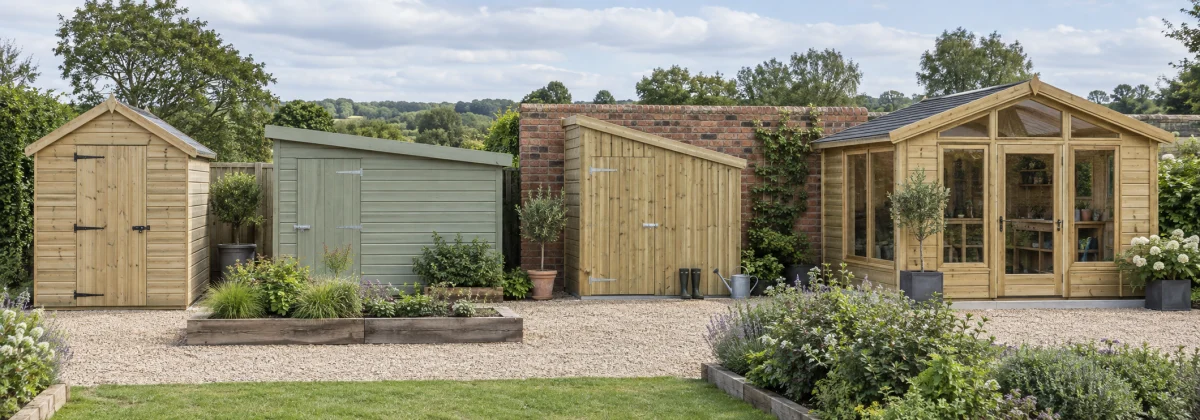
“8x6 apex shiplap workshop” is not one mysterious shed type. It is a size, a roof shape, a wall profile and a job. Start with what the building must do, then choose its shape and construction. The searchable A–Z glossary below defines every component in detail.
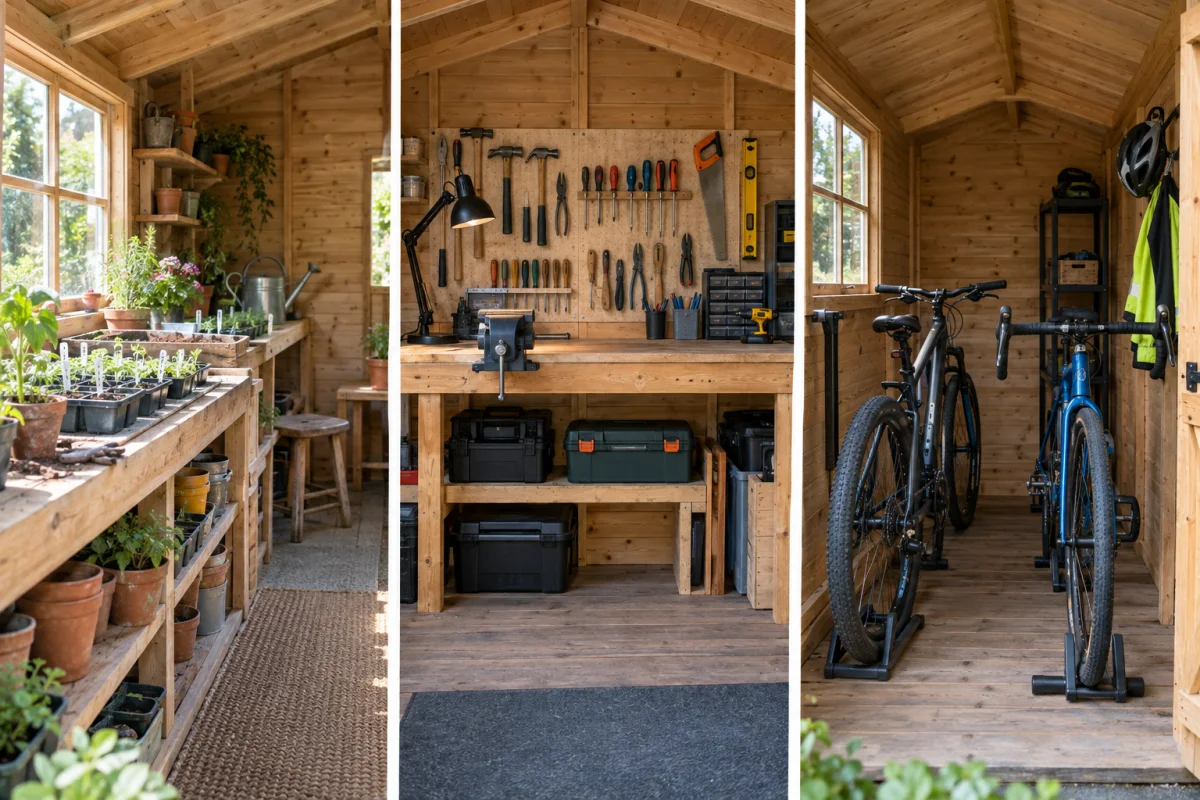
| Type | What distinguishes it | Check before buying |
|---|---|---|
| Storage or tool shed | Dry general storage with simple single-door access. | Clear opening, shelf fixings, security and usable wall space. |
| Workshop | Standing room, bench light, wider doors and a stronger working floor. | Joists, deck, frame section and actual eaves height—not the badge. |
| Potting shed | Large sloping glazing over staging, combining greenhouse light with storage. | Orientation, summer ventilation, safety glazing and bench depth. |
| Bike shed | Long, low secure storage arranged around a bicycle's geometry. | Handlebar clearance, threshold, anchors and door swing. |
| Garden office or studio | A regularly occupied room rather than weatherproof storage. | Insulation, ventilation, electrics, glare, heating and permissions. |
| Summerhouse | Leisure space with more glazing and a front designed around sitting. | Privacy, furniture layout, security and shoulder-season comfort. |
| Log cabin | Solid interlocking wall boards form the structure and settle seasonally. | Wall thickness, corner joints, settlement details and base accuracy. |
| Lean-to store | A narrow single-slope building placed against or beside another wall. | Flashing, gutter route, wall ventilation and whether it is truly freestanding. |
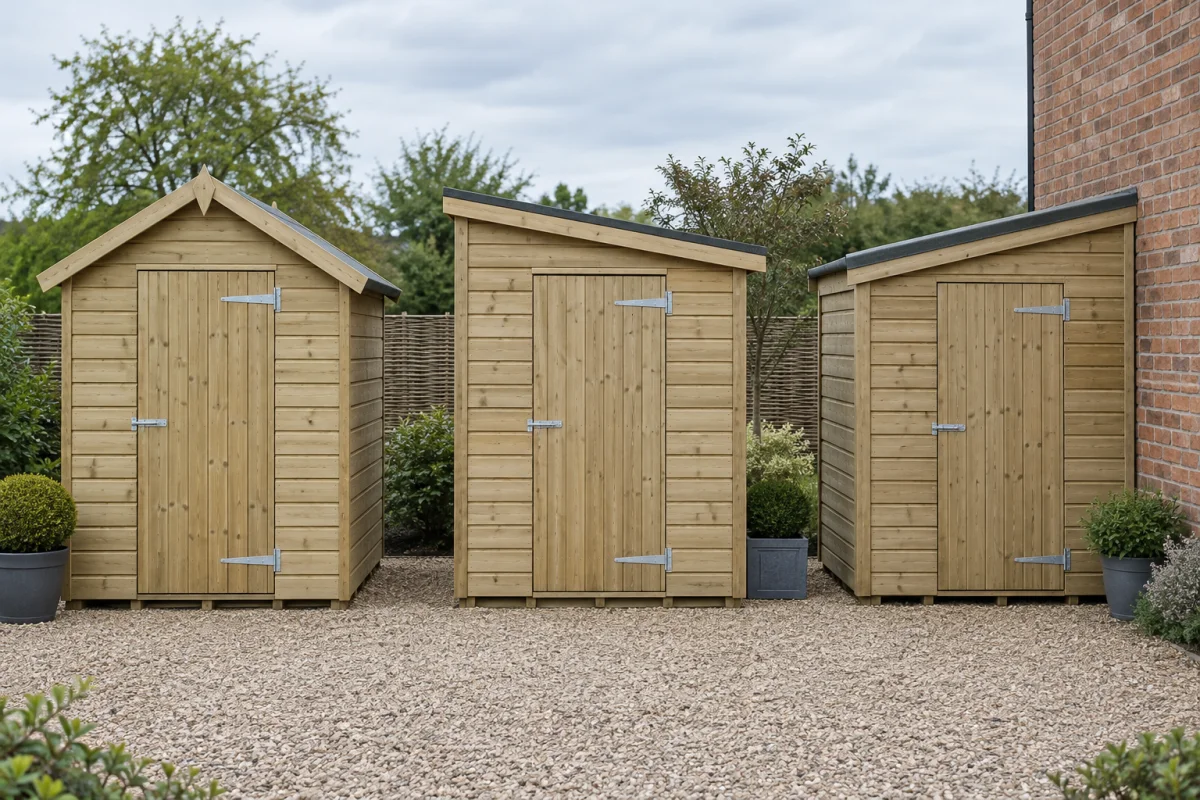
An apex roof has two slopes meeting at a ridge and gives useful central headroom. A pent roof has one continuous slope, keeping its highest point to one side and sending all rain to the other. “Reverse apex” simply puts the door in the long wall rather than the gable. A flat roof is never truly level: it has a small designed fall beneath the visible edge.
The apex versus pent guide handles the choice; glossary entries below define ridge, eaves, verge, fascia, bargeboard and roof pitch.
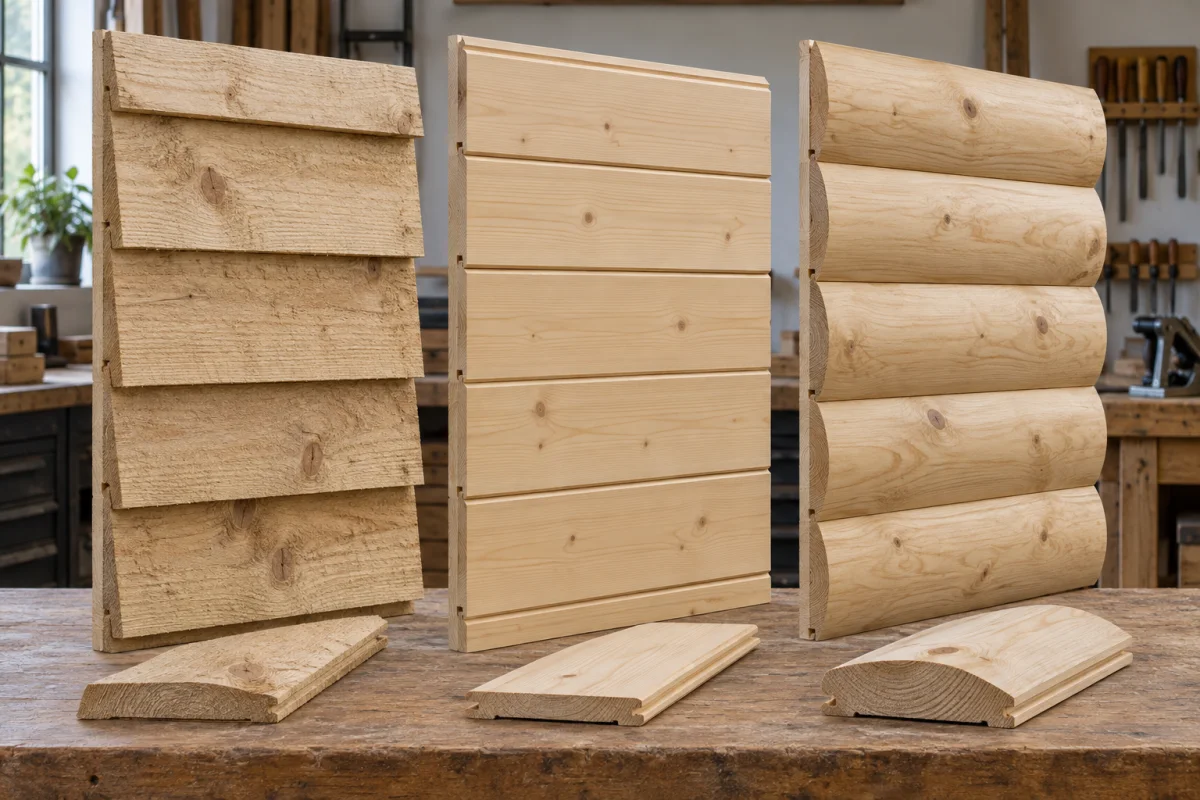
Overlap boards cover the edge of the board below and are economical, airy and tolerant of movement. Shiplap boards interlock—normally with a tongue and groove—and have a weather-shedding face. Loglap is a thicker rounded interlocking profile that looks cabin-like but remains cladding over a frame unless the wall boards themselves interlock at the corners.
Compare finished board thickness, not only words such as “premium”. A tongue-and-groove joint may appear on walls, floors or roofs; it describes the joint, not a complete quality grade. The cladding comparison guide covers performance and value.
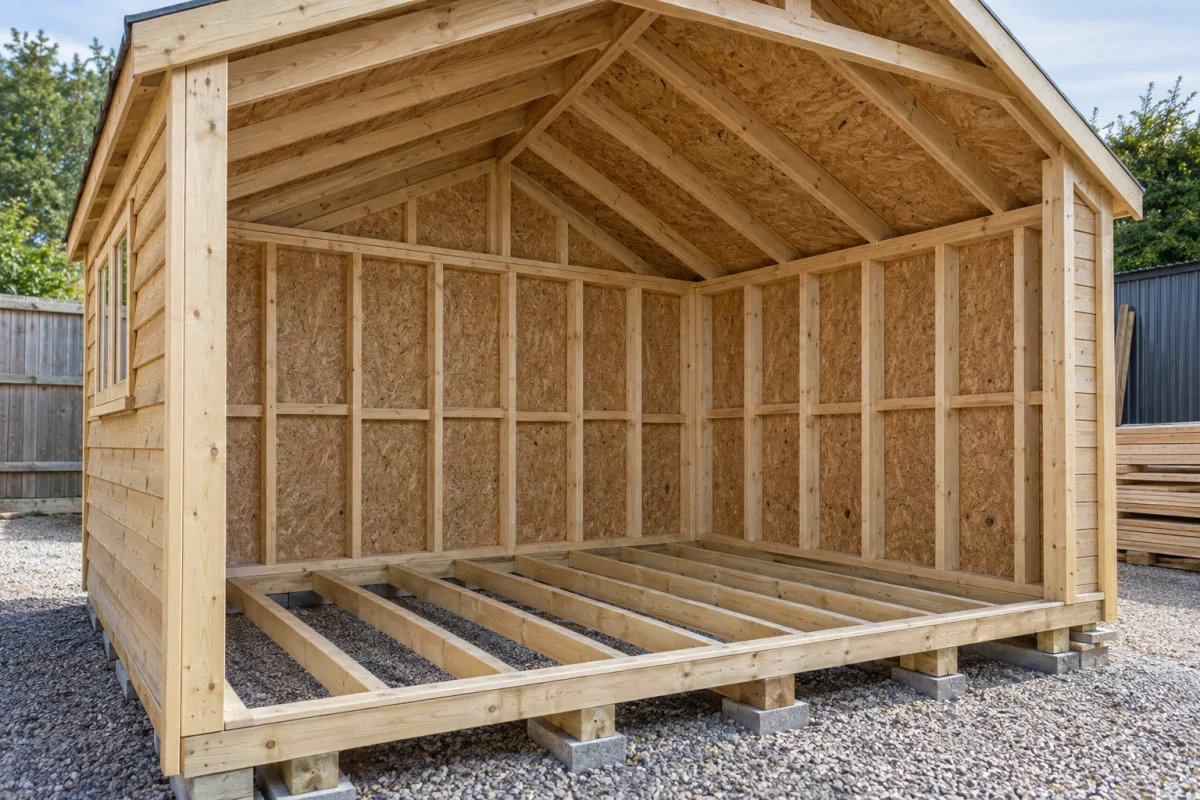
Bearers sit beneath the floor frame. Joists carry the floor deck; studs form the vertical walls; noggins restrain and connect framing; rafters carry the roof. Top and sole plates join the ends of studs, while diagonal bracing or structural sheet material prevents the frame racking into a diamond.
“Heavy duty” has no common threshold. Frame cross-section, spacing, timber grade, joints and the spans between supports are the useful facts. The timber sizes guide translates nominal sizes and C16/C24 grading.
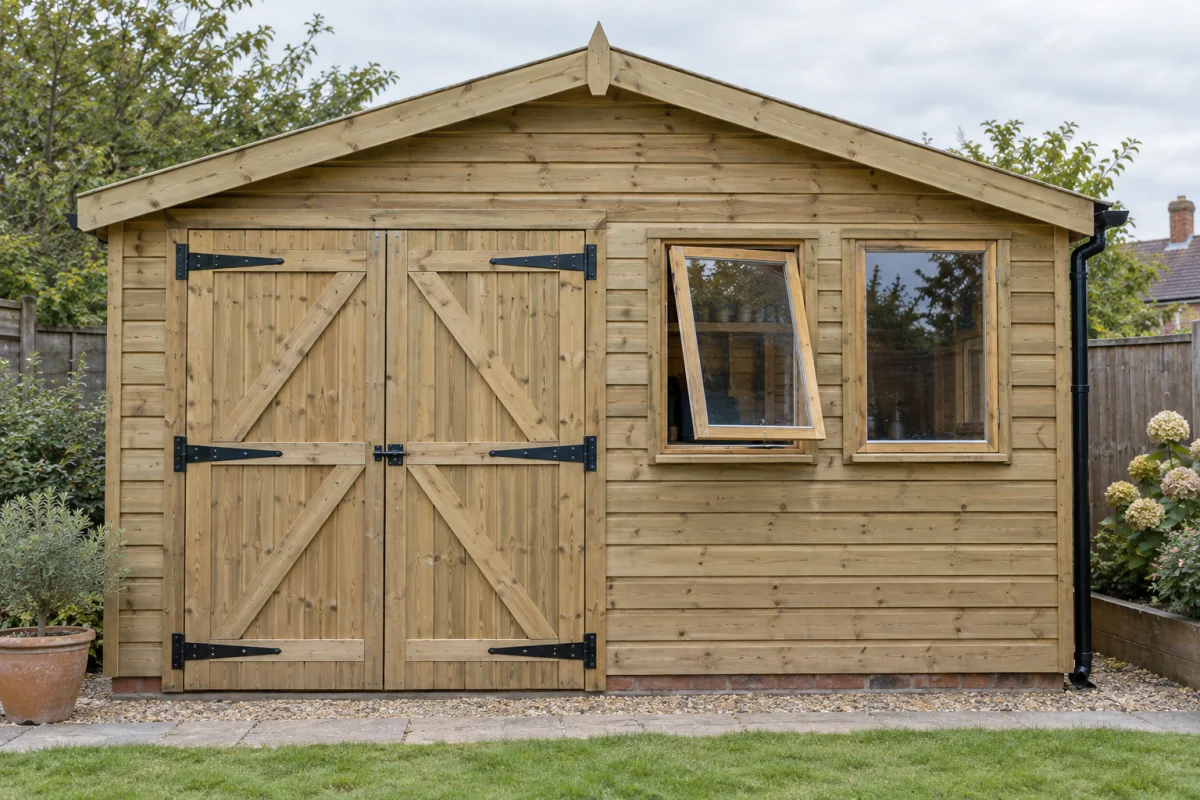
A ledged and braced door has horizontal ledges plus diagonal braces that resist sag. Tee hinges are surface-mounted T-shaped hinges; their length and fixings matter as much as their colour. A fixed light is a window that does not open, while an opening light does. Glazing beads are the slender strips retaining glass or plastic in its frame.
Always compare the clear door opening rather than the leaf's outside size. For glazing, identify the actual material—styrene, acrylic, polycarbonate or toughened glass—and whether safety and security claims have supporting detail. The windows and doors guide covers fitting.
Then verify base size, overall roof size, internal dimensions, eaves and ridge heights, clear door opening and the largest delivery panel. Words such as deluxe, heritage and security are marketing until those numbers explain them.
193 terms and counting.
An L-shaped metal bracket screwed across an internal corner to brace and stiffen a joint. Quick way to firm up a frame or fix a rail square to a post.
A pitched roof with two equal slopes meeting at a central ridge, giving the classic A-frame shed shape. It sheds water well off both sides and gives good headroom down the middle.
See: Apex vs pent roof shedsThe trim board run along the sloping verge of a gable end, the angled cousin of the fascia. It tidies the roof edge and protects the ends of the roof timbers.
A sliding bolt running in a tubular barrel that you push across into a staple to secure a door. Similar to a tower bolt and common on the inside of shed doors.
The spacing set out between roof battens so that tiles or slates lap correctly, worked out from the size of the covering. Getting the gauge right means full courses top and bottom.
A length of treated timber laid flat on the ground or base that the floor joists sit on, spreading the load and keeping the floor clear of the ground. Often the first thing you set down on a slab or paving.
See: Building a shed foundationAn angled cut or surface that is not square to the face. A sliding bevel is the tool used to set and copy an angle from one piece to another.
A thin layer of sand or fine material spread over coarse hardcore to fill the surface voids and give a smooth bed. It stops sharp stones puncturing a membrane or damp proof course laid over it.
See: How to build a shed foundationA cladding style of wide vertical boards with narrow battens fixed over the joints between them. It gives a strong, traditional look and lets the wide boards move without opening gaps.
See: Shed cladding options comparedA bend along the length of a board on its flat face, so the ends lift while the middle sits down or the reverse. A bowed joist is best fitted crown up so the load straightens it.
A diagonal timber fixed across a frame to stop it leaning over sideways, the timber version of a triangle keeping things square. Essential for stopping a shed racking out of shape.
A roofing membrane laid under the covering that keeps wind-driven rain out while letting water vapour escape from inside. It helps stop condensation forming in the roof.
A sheet fixed behind the cladding that keeps wind and rain out while letting moisture vapour pass through from inside, also called a breather paper. It stops driven rain reaching the frame and helps the wall dry out.
See: Stopping shed condensationThe common two-leaf hinge let into the edge of a door and its frame so the leaves close flat against each other. Strong and tidy, but needs recessing in for a good fit.
See: Installing shed windows and doorsThe simplest joint, where the end of one piece of timber is brought up square against another and fixed with nails or screws. Quick to make but the weakest joint, so it usually needs a bracket or plate to back it up.
A strength grade for structural softwood, the common general-purpose grade for joists and rafters. Strong enough for most shed work and cheaper than the higher grade.
A higher strength grade of structural softwood than C16, used where you need to carry more load or span further. Worth the extra for longer floor joists or a heavy roof.
A swinging hook and eye used to hold a door or window open or loosely shut. Handy for holding a shed door back against the wind.
A window hinged at the side that swings open like a door. The most common opening window in a shed or house, fixed into a frame within the opening.
A tensioned steel wire strung between two fixed points to carry a cable through the air, for example an overhead supply across to a shed. The cable is clipped to the wire so it does not take the strain itself.
A thin tapered wooden tile, usually western red cedar, laid in overlapping courses for a smart natural roof. Long-lasting and good-looking but more work and cost than felt.
A string coated in coloured chalk that is pulled tight and snapped against a surface to leave a straight guide line. Quick for marking long cuts or fixing lines on a board or base.
A flat bevel cut along an edge or corner to take off the sharp arris, usually at 45 degrees. It tidies an edge and stops it chipping or catching.
The bottom horizontal member of a window or door frame, also spelt sill, shaped with a weathered slope and a drip to throw rain clear of the wall below. The part that takes the most weather.
A short galvanised nail with a large flat head, made for fixing felt and roofing without the head pulling through. The standard fixing for nailing down mineral felt.
See: Installing roofing feltCanadian Lumber Standard timber, planed softwood with rounded edges in standard sizes such as 38 by 63mm, widely used for stud framing. Clean and consistent, it is the go-to for internal frames.
A bolt with a domed head and a square collar under it that bites into the timber so it cannot spin while you tighten the nut. Used for heavy structural joints such as fixing frames to a base.
A horizontal timber fixed between a pair of opposite rafters partway up, stopping the roof from spreading and pushing the walls out. Sometimes just called a collar.
An adjustable square with a sliding head that marks and checks both 90 and 45 degree angles, and doubles as a depth and marking gauge. A handy all-round setting out tool.
Water that forms when warm moist air meets a cold surface, the curse of an uninsulated shed in winter. It is controlled with ventilation, insulation and a vapour control layer.
A protective tube, plastic or metal, that cables are run through to shield them from damage. Used where wiring is run on the surface or buried in a wall.
The box that takes the incoming supply and splits it into separate protected circuits, fitted with the main switch, RCD and breakers. Any work on one should be left to a qualified electrician.
See: Shed electrical installation basicsTo shape the end of one moulded piece so it fits over the face of another at an internal corner, instead of mitring. Common on skirting and trim, and tidier where walls are not quite square.
Lightweight corrugated roofing sheets made of bitumen-soaked fibres, widely known by the brand name Onduline. Quick to fix and good over open rafters or a light roof.
To drill a tapered recess so a screw head sits flush with or just below the surface, or the bit that cuts it. It stops the head standing proud and snagging or splitting the timber.
A narrow strip of timber fixed over a joint or gap between two boards to weatherproof it and tidy the line. The batten in board and batten cladding is one example.
A type of warping where a board curves across its width, so the face is no longer flat. Boards cup as they dry unevenly, more so on wide flat-sawn stock.
The land immediately around your house that counts as part of the property, within which permitted development rights normally apply. A shed outside the curtilage may need full planning permission.
A fixed reference point or level that all other measurements on a job are taken from. Setting a datum keeps a base and the building worked off one consistent level.
A penetrating oil finish for outdoor timber that feeds the wood and resists water without forming a film. It needs topping up regularly but will not flake.
A corrosion-resistant screw with a coating made for outdoor timber, designed not to rust and stain the wood. The coarse thread and sharp point drive into softwood without splitting it.
The temperature at which moist air gets cold enough for the water in it to condense into droplets. If a surface in the shed drops to the dew point you get condensation and damp.
See: Stopping shed condensationDamp proof course, a waterproof layer built into a wall to stop ground moisture rising up through it by capillary action. On a shed it keeps damp from wicking into the bottom of the frame.
Damp proof membrane, a sheet of heavy polythene laid under or within a concrete slab to stop ground moisture coming up through the floor. Lap and seal the joints or damp will find a way through.
A seal of brush, foam or rubber fitted round a door or window to close the gap and stop cold air getting in. A cheap way to make a shed more comfortable.
See: How to insulate a shedA formed edge or trim at the bottom of the roof that makes water drip clear instead of running back under the felt or down the fascia. Also called a drip cap or drip batten.
The lower edge of a roof where it meets the top of the wall, usually where the rainwater runs off into the gutter. Eaves height is the measurement from ground to this point and matters for planning rules.
The height from ground level to the point where the wall meets the roof at the eaves, a key figure in the planning rules for outbuildings. Keeping it below the limit, often 2.5 metres near a boundary, helps stay within permitted development.
See: Shed planning permissionA treatment painted onto the cut ends of timber, which soak up water far faster than the faces, to slow moisture getting in. Sealing cut ends is one of the best ways to stop rot starting.
See: Treating and preserving shed timberA synthetic rubber membrane laid as a single sheet to give a seamless, long-lasting flat or pent roof covering. More money up front but it can outlast felt many times over.
A deliberate slight slope built into a surface so water runs off to where you want it. A paved base or a flat roof is laid with a fall to drain it.
The board fixed to the ends of the rafters at the eaves, giving a neat finish and something to fix the guttering to. On a shed it is often the same board the felt is dressed over.
Cladding boards sawn thick on one edge and thin on the other, fixed overlapping to throw water off, traditionally seen on fencing and rustic sheds. Sometimes called featheredge.
See: Shed cladding optionsA paste used to fill holes, splits and gaps in timber before finishing, then sanded flush once set. Use an exterior grade flexible filler outdoors so it moves with the wood.
The actual measured size of a piece of timber after it has been planed, which is smaller than its nominal name. A nominal 50mm planed batten often finishes around 45mm.
A pane of glass set permanently into a frame that does not open. Used where you want daylight and a view but no ventilation.
A strip of lead, metal or membrane used to weatherproof the joint where a roof meets a wall or where a lean-to abuts a building. It directs water away from the vulnerable join.
The temporary timber boxing built to hold wet concrete to shape until it sets, also called shuttering. It is struck, or removed, once the concrete has gone off.
The skeleton of timber, made of plates, studs, joists and rafters, that everything else is fixed to. A square, well-braced frame is the difference between a shed that lasts and one that sags.
A gravel-filled trench, usually with a perforated pipe in the bottom, that collects and carries water away from where it is not wanted. Useful for keeping a damp slope from running at a shed base.
The triangular section of wall at the end of an apex roof, formed between the two roof slopes. Often the end where the door goes on a smaller shed.
A catch that holds a gate or door closed but lets it open by lifting or pressing a lever, without needing a bolt. The automatic gravity type drops shut on its own.
A thin strip of timber or plastic that holds a pane of glass into its frame once the glass is in place. It is pinned or clipped in and can be removed to replace the glass.
See: Installing shed windows and doorsThe direction and pattern of the fibres running through a piece of timber. Working with the grain gives a clean cut, while going against it tears and splinters the surface.
A board fixed along the bottom of a fence or shed wall to take the wear and damp at ground level, so the cladding above stays clear of the soil. It is cheaper to replace than the panel.
Freshly sawn oak that still holds a high moisture content and has not been seasoned. It is easier to work when green but moves and splits as it dries, so joints are cut to allow for it.
Large galvanised steel screws wound deep into the ground to support a building without digging or concrete. Quick to install and good on awkward or sloping ground.
A flat plate of plywood or metal fixed across a joint to tie the timbers together and stop them moving, often used at the apex and feet of a truss. It spreads the load over a wider area.
A joint where half the thickness is cut from each piece so they overlap flush and finish the same depth as a single board. Often used where two rails cross or meet at a corner.
A hinged metal plate (the hasp) that drops over a loop (the staple) to take a padlock, the classic shed door lock. Fit a closed-shackle padlock and coach bolt it on for proper security.
See: Shed security tipsA wedge of concrete laid along the back or base of a kerb, post or slab edge to hold it firm. It locks the edge in place so it cannot tip or shift.
The older, central timber of the tree, usually darker, harder and more naturally durable than the sapwood around it. It resists rot better but is slower to take up preservative.
A fixed steel pin set into the hinge side of a door that engages a hole in the frame, stopping the door being levered off even if the hinges are attacked. A cheap and effective bit of shed security.
See: Shed security tipsThe external angle where two sloping roof surfaces meet at a corner, running from eaves up to ridge. A hipped roof slopes on all sides rather than having a flat gable end.
A joint where a square channel is cut across one piece and the end of another sits into it, common for fitting shelves into uprights. Also called a dado in some quarters.
A two-digit code showing how well a fitting is sealed against solids and water, the higher the numbers the better the protection. Outdoor and shed fittings need a suitable IP rating for damp conditions.
A shortened rafter that runs from the wall plate up to a hip or down to a valley, rather than the full way to the ridge. Each one in a run is a different length.
One of the horizontal timbers that carries the floor, spanning across the base and fixed to the bearers. Closer spaced joists give a stiffer, stronger floor.
See: Building a shed foundationA galvanised steel bracket that supports the end of a joist where it meets another timber, saving you skew nailing into end grain. It gives a strong, square joint quickly.
The slot of material removed by a saw blade as it cuts, equal to the blade thickness. You allow for the kerf when marking, cutting to the waste side of the line.
Timber dried in a kiln to a low, controlled moisture content rather than left to air dry. It is more stable and less likely to twist, warp or shrink once you have built with it.
A central vertical timber in a roof truss that runs from the tie beam up to the ridge, supporting the ridge and tying the structure together. Common in traditional framed roofs.
The hard, often darker mark left in a board where a branch grew out of the trunk. Knots can weaken timber and bleed resin, and live knots should be sealed before painting.
A shellac-based liquid brushed over knots before priming to stop resin bleeding through and spoiling the paint. A cheap step that saves stained patches later.
A tough, naturally durable softwood often used for cladding and gates, prized for weathering well to a silver grey if left unfinished. Heavier and more resinous than common softwood.
See: Shed cladding options comparedA tool that projects a perfectly level or plumb line of light across a surface for setting out. It lets one person mark a level line right round a room or wall.
A simple framed door of vertical boards held by horizontal ledges and diagonal braces, common on sheds and outbuildings. The brace runs up from the hinge side to stop the door dropping.
See: Installing shed windows and doorsCladding boards with a rounded face that gives the look of stacked logs while sitting flat behind. A thicker, more solid profile popular on cabins and summerhouses.
A separate thin strip of timber or ply fitted into matching grooves cut in two boards, joining them like a tongue and groove without either board having its own tongue. Useful for joining boards edge to edge.
A flexible gun-applied sealant used to seal joints and gaps against water and draughts, also just called sealant or sometimes gunge on site. Use the right grade for outdoor and frame work so it stays flexible.
A miniature circuit breaker that protects a circuit by tripping off if the current gets too high, replacing the old rewirable fuse. Sized to suit the cable and load by the electrician.
A flat metal strip with screw holes used to bridge and strengthen a joint or repair a split. The straight version reinforces a butt joint along its length.
An exterior paint that lets water vapour escape from the timber while keeping rain out, so it flexes with the wood rather than blistering. A good choice for shed cladding and joinery.
Traditional bitumen roofing felt with a mineral granule surface, nailed or stuck down over a roof deck. The standard low-cost shed roof covering, usually good for several years.
See: Installing roofing feltA soft fibrous insulation made from spun rock or glass, sold in rolls and slabs to fit between studs and joists. Cheaper than PIR and good at deadening sound as well as keeping heat in.
A joint where two pieces are each cut at an angle, usually 45 degrees, so they meet to form a corner with no end grain showing. Common on architrave and trim round doors and windows.
A powered saw on a pivot that drops a circular blade to make accurate square and angled cross cuts. The tool of choice for cutting trim and framing to length and angle.
The amount of water held in a piece of timber, given as a percentage of its dry weight. Fixing timber that is too wet leads to gaps and movement as it dries out.
A strong traditional timber joint where a projecting tongue (the tenon) on one piece fits into a matching slot (the mortise) in another. The backbone of framed doors and timber framing.
See: Installing shed windows and doorsA graded crushed stone aggregate to a Department for Transport specification, used as a compacted sub-base under bases and slabs. It locks together when whacked down to give a firm, free-draining foundation.
See: Building a shed foundationThe upright timber that divides a window into two or more separate lights. A horizontal divider doing the same job is called a transom.
A small tapered steel tool struck with a hammer to drive a nail head just below the timber surface. The set hole is then filled so the fixing does not show.
A short horizontal timber fixed between studs or joists to stiffen the frame and stop the longer timbers twisting or bowing. It also gives a solid fixing point for shelves or cladding joints.
The size a piece of timber is sold and called by, taken before it is planed, so a 4 by 2 is named 100mm by 50mm even once it is smaller. Always check the finished size for setting out.
A way of measuring spacing from the centre of one timber to the centre of the next, often written as o.c. or at 400 centres. It keeps board joints landing neatly on the timbers.
Oriented strand board, a sheet material made from compressed wood strands glued in layers, used for floors, roofs and wall sheathing. OSB3 is the moisture-resistant board to use for shed work.
The part of the roof that projects past the face of the wall at the eaves or verge. A decent overhang throws rainwater clear of the cladding and keeps it drier.
A simple, budget cladding where plain sawn boards are fixed horizontally each overlapping the one below to keep the rain out. Cheap and quick but less weathertight than shiplap.
See: Shed cladding optionsA small piece of timber or plastic slipped behind or under a component to take up a gap and bring it to the right line or level. Also called a shim, and used to plumb a door frame in an opening.
See: Installing shed windows and doorsA sliding bolt with a hole or staple in the shoot so a padlock can be passed through to lock it. A simple way to add security to a shed door.
See: Shed security tipsA small isolated block of concrete cast in the ground to carry the load of a single post or pier. A row of pads can support a bearer instead of a full slab.
See: How to build a shed foundationPlaned all round, meaning the timber has been machined smooth on all four faces to a consistent finished size. Used where a clean surface matters, such as trim, framing and joinery.
The part of the Building Regulations covering electrical safety in and around the home, including a supply run out to a shed. Notifiable work should be done or signed off by a qualified electrician.
See: Shed electrics basicsA shed base made of concrete paving slabs laid on a bed of sand and compacted sub-base. A popular and forgiving option that gives a flat, solid platform without pouring concrete.
See: Building a shed foundationA flat washer with a large outer diameter relative to its hole, used to spread the load of a bolt or screw over soft or thin material. It stops the head pulling through.
A single sloping roof that falls from a higher front to a lower back, often called a lean-to style when it leans on another building. Tidy under a low eaves height and easy to build.
See: Apex vs pent roof shedsThe rules that let you put up a garden building without a full planning application, provided you stay within set limits on size, height and position. Most sheds fall under it but always check before you build.
See: Shed planning permissionA clear rigid acrylic sheet used as a lightweight, shatter-resistant alternative to glass for small windows. It scratches more easily than glass but is safer if knocked.
A small hole drilled before driving a screw or nail, guiding it in and stopping the timber splitting. Always worth it near the ends of boards and in hardwood.
Polyisocyanurate insulation board, a rigid foam with foil facings that gives a high level of insulation for its thickness. The go-to board for insulating shed walls and roofs where space is tight.
See: Insulating a shedTimber that has been machined smooth on its faces, sold as PAR (planed all round) or PSE (planed square edge). The finished size is a few millimetres under the sawn size because of the planing.
A petrol-driven machine with a heavy vibrating base used to consolidate sub-base and hardcore. Often called a whacker plate, it gives a firm, settled base that will not sink later.
See: How to build a shed foundationTruly vertical, checked with a spirit level or plumb line. A wall or post that is plumb is dead upright with no lean.
A pointed weight hung on a line to show a true vertical by gravity. The simplest way to check a post or wall is dead upright.
A sheet material made from thin layers of veneer glued with the grain crossed for strength. Use exterior or marine grade ply where it may get damp, such as a shed roof deck.
A tough, light plastic glazing, often in twin-wall sheet, used where glass would be too heavy or fragile. Common on shed and greenhouse roofs as it is hard to break.
The first coat applied to bare timber to seal it and give the following coats something to grip. Painting straight onto bare wood without a primer leads to early failure.
See: Treating and preserving shed timberA garden shed kitted out as a private bar or social space, complete with seating, lighting and often a proper draught setup. A British favourite and a brilliant project to take on.
See: How to build a pub shedA horizontal beam running the length of the roof partway up the slope, carrying the rafters between ridge and eaves over a longer span. On bigger sheds it stops the rafters sagging.
When a frame leans and goes out of square under sideways force, turning a rectangle into a parallelogram. Bracing and proper sheathing are what stop a shed racking.
One of the sloping timbers that runs from ridge down to the wall plate and forms the framework of the roof. The roof boards or sheets are fixed to the rafters.
A residual current device that cuts the power fast if it detects current leaking to earth, protecting against electric shock. Required on shed circuits, and one for the electrician to fit.
See: Shed electrical installation basicsA stepped recess cut along the edge or face of a timber so another piece sits into it, such as the lap on shiplap boards. Pronounced rabbet by some of the older trade.
European softwood from Scots pine, a strong straight-grained timber that takes preservative and paint well. The usual choice for good quality joinery, windows and doors.
See: Treating and preserving shed timberSawn timber that has been machined to a consistent depth on the two main faces so every piece in a batch is the same width. Used for joists and rafters so the tops line up true.
The horizontal line along the very top of an apex roof where the two slopes meet. It is the highest point and usually needs a ridge cap or capping piece to keep water out.
A structural beam running along the ridge that carries the top ends of the rafters, used where the rafters need real support rather than just a ridge board. It bears down onto the gable walls or posts.
The length of timber that runs along the ridge and which the tops of the rafters are fixed against. It sets the line of the roof and helps tie the two slopes together.
A nail with rings rolled into the shank that grip the timber and resist pulling out, also called an annular ring nail. Ideal for fixing floors and cladding that get a lot of movement.
The angle or steepness of the roof slope, given in degrees or as a rise over run. A steeper pitch sheds water and snow better but uses more timber and felt.
Timber straight from the saw with a coarse, hairy surface and full nominal dimensions, not planed smooth. Cheaper and stronger for its size, fine for framing and bearers.
The outer, younger band of timber just under the bark, paler and less durable than the heart. It takes preservative readily but rots faster if left untreated.
A long bar clamp used to pull a frame or panel together while the glue sets. Essential for cramping up doors and framed joinery square.
A joint used to join two lengths of timber end to end, with matching angled or stepped cuts so they overlap and bond into one longer piece. Handy for making up a wall plate or fascia run that is longer than your stock.
A levelled layer of sand and cement, or a similar mix, laid to give a smooth, true surface. Also the act of striking off a surface level with a straight edge.
To mark and cut a piece of timber so it follows the exact line of an uneven surface it has to sit against, such as a wall or floor. Gives a tight fit where a straight cut would leave gaps.
Timber that has been dried, by air or kiln, down to a stable moisture content suitable for use. Seasoned stock moves far less than green timber once it is in place.
To mark out the position, size and square of the base or frame on the ground before you start building, using pegs, lines and measurements. Time spent setting out properly saves no end of grief later.
A split or crack running along the grain of timber, usually caused by drying or stress in the growing tree. A bad shake weakens a structural piece and is best cut out.
A profiled cladding board with a curved rebate that overlaps the board below, shedding water neatly down the face of the wall. One of the most popular and weathertight shed claddings.
See: Shed cladding optionsA pit or trench filled with rubble or crates that collects rainwater run-off and lets it drain slowly into the surrounding ground. Used where there is no drain to take the water.
The board that closes off the underside of the roof overhang between the fascia and the wall. It keeps weather and birds out of the eaves and helps with airflow if vented.
The bottom horizontal timber of a stud wall frame that sits on the floor or base, also called the bottom plate. The studs are fixed up off it.
The clear distance a joist, rafter or beam has to bridge between its supports. The greater the span, the bigger or closer the timbers need to be to carry the load.
A tool with bubble vials used to check whether a surface is level or plumb, the bubble sitting central when it is true. The most reached-for tool on any shed build.
A corner or frame at a true right angle of ninety degrees, checked with a builder's square or by measuring the diagonals. If the diagonals match, the frame is square.
A hinge with two long straps that fix across the faces of both the door and the post or frame, carrying heavy or wide doors. Often seen on barn doors and field gates.
A taut length of line strung between pegs or pins to give a straight reference for setting out, levelling or lining up courses. Cheap, simple and indispensable for getting things straight.
A vertical timber in a framed wall, running between the sole plate and the head plate. The studs carry the wall load and give you something to fix the cladding and lining to.
The distance between the centres of adjacent studs in a wall, commonly 400mm or 600mm on a shed. Closer spacing makes a stronger wall and suits standard board widths.
The compacted layer of hardcore or MOT Type 1 that sits between the ground and the slab, spreading the load and keeping it level and stable. Get this right and the base will not sink or move.
Steel wire armoured cable, with a protective steel braid under the outer sheath, used to run a supply underground out to a shed. The armour resists damage and can act as the earth, but termination is a job for an electrician.
See: Shed electrical installation basicsThe trade nickname for pressure-treated timber, after the Tanalith preservative process. Tanalised timber has a slightly greenish tint and lasts far longer outdoors than untreated wood.
See: Treating shed timberA hinge shaped like a letter T, with a long strap that spreads across the face of a ledged door and a short part fixed to the frame. The usual choice for shed and gate doors.
A small hand saw with a stiffening rib along the top of the blade for accurate straight cuts in joinery. Named for cutting tenons, it gives a fine, controlled cut.
The bottom member of a doorway that you step over, sealing the gap under the door against weather and draughts. An outward weathered threshold sheds rain away from the inside.
A triangular strip of timber fixed at the eaves to lift the bottom edge of the first row of tiles or felt, so water is thrown clear of the fascia. Also called a sprocket on some roofs.
See: Installing shed roofing feltA toothed metal plate or ring fitted between two bolted timbers to spread the load and stop the joint slipping. Used in trusses and heavier framed work.
The small amount of acceptable variation allowed in a measurement or fit. Leaving a sensible tolerance round a door or window lets you adjust it square in the opening.
Boards machined with a tongue on one edge and a groove on the other so they lock together into a solid, draught-tight surface. Often shortened to T and G and used for floors, cladding and linings.
See: Shed cladding optionsA window hinged along its top edge so the bottom swings outward, letting it stay open in the rain. Often used as a vent above a fixed light.
A heavier polyester-reinforced bitumen felt melted onto the roof with a gas torch so it bonds and seals fully. Far more durable than nailed felt and worth it on a flat or low-pitch roof.
A surface-mounted sliding bolt where a round bar shoots into a keeper to hold a door or gate shut. Simple and robust, fitted to the face of the timber.
Softwood timber that has had preservative forced into it under pressure to resist rot and insect attack, also called tanalised after a well-known brand. The standard choice for anything outdoors or near the ground.
See: Treating shed timberA triangulated frame of timbers that carries the roof load and spans between the walls without needing internal support. Often made up as a unit on the ground and lifted into place.
A type of warping where the timber winds along its length so the four corners no longer sit in the same plane. Also called wind, and a twisted piece is hard to fix down flat.
A measure of how much heat passes through a building element such as a wall or roof, measured in watts per square metre per degree. The lower the U-value, the better the insulation.
A coat applied over the primer to build the film and provide a uniform base for the topcoat. It helps hide the grain and gives the final colour an even finish.
A board profile with a small V-shaped channel machined along the joint, so the line between boards reads as a neat shadow gap. Common on tongue and groove cladding and matchboarding.
The internal angle where two roof slopes meet and run downhill, channelling rainwater. It needs careful flashing or a valley gutter as it carries a lot of water.
A sheet, often called a VCL, fitted on the warm inside face of insulation to stop moist air passing into the wall or roof where it would condense. The other half of getting condensation under control.
The sloping edge of a pitched roof at the gable end, running from eaves up to ridge. It is the edge that the barge board finishes off.
Cladding boards run up and down rather than across the building, which sheds water quickly and suits a tall look. It needs horizontal battens behind to fix to.
A horizontal timber laid along the top of a wall to spread the roof load and give the rafters a fixing. On a shed it ties the top of the wall together.
A plastic or fibre sleeve pushed into a drilled hole in masonry so a screw bites and holds fast. Often called a rawl plug after the original brand, and sized to match the screw.
A raised strip fitted to a cill or threshold, or a groove and seal, that stops wind-driven rain working its way under a door or window. It keeps water on the outside.
A shaped strip fixed to the bottom of a door to throw rainwater out clear of the threshold, also a name for overlapping wall cladding boards. The door version stops water creeping back under the door.
See: Installing windows and doorsA woven or non-woven sheet laid on the ground to stop weeds growing up through gravel or under a base. It lets water through but blocks the light plants need.
European softwood from spruce, lighter in colour than redwood and a touch less durable, often used for carcassing and framing. It does not take preservative as readily as redwood.
A treatment brushed, sprayed or dipped onto timber to protect it from rot, fungus and insect attack. Cut ends and untreated timber should always get a coat before the weather gets at them.
See: Treating shed timberA finish that colours timber while letting the grain show through, and which often carries preservative. Unlike paint it soaks in rather than forming a thick skin, so it weathers by fading rather than peeling.
See: Treating and preserving shed timberA threaded fixing driven into timber that pulls two pieces tightly together and can be undone later. Choose a length that gives good purchase in the second piece without breaking through.
Design your shed with the free builder and get a materials list that uses all of these terms properly.
Start Building Now