How to Keep a Shed Cool in Hot Weather
Why sheds turn into ovens in summer, what the heat quietly ruins (tools, paint, batteries, plants and pets), and the fixes that actually work, from free habits to vents, shade, reflective roofs and insulation.
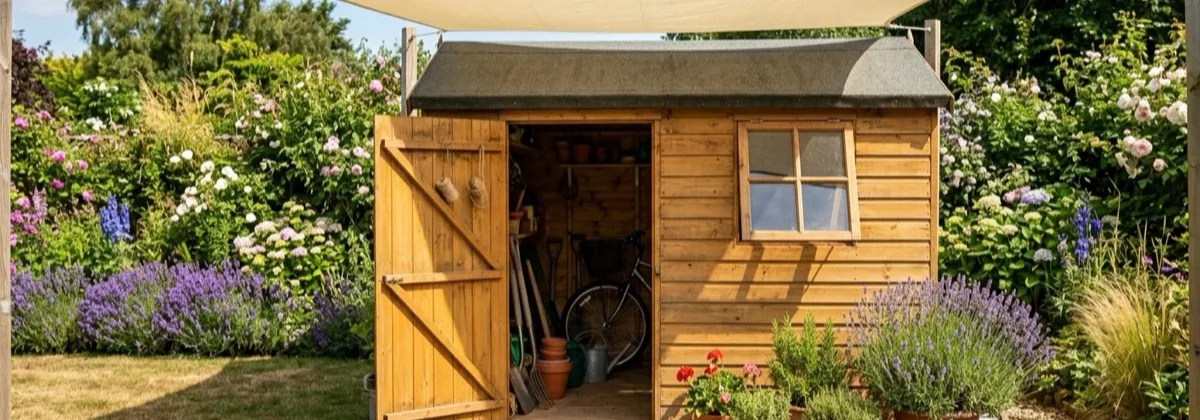
A shed in a heatwave is a greenhouse with the vents painted shut. Thin walls, a dark felt roof, a sealed door and a small volume of trapped air add up to internal temperatures that regularly pass 40°C on a hot British afternoon. That is unpleasant if you are working in it, and quietly destructive if you are storing things in it: glue, paint, batteries, electronics, timber and anything alive all suffer long before you notice. The good news is that cooling a shed is mostly a passive problem with cheap passive answers. This guide explains why sheds overheat, what the heat actually ruins, and the fixes in the order you should try them.
Stop the sun landing on the shed (shade, light roof), let hot air escape (high and low vents), slow what gets through (insulation), and never store aerosols, lithium batteries or animals in a sealed shed through a heatwave.
Why Sheds Overheat
Four things gang up on a shed in summer, and none of them apply to your house to the same degree.
The roof is a solar collector. Traditional bituminous felt is dark, thin and laid directly over a boarded deck. In direct sun the surface of dark felt can pass 70°C, and with no insulation below it that heat radiates straight down into the room. The roof has the largest area facing the sun at the steepest angle, which makes it the single biggest source of heat gain.
The walls are single skin. Most sheds have 12mm to 15mm of cladding between outside and inside, with no cavity and no insulation. Timber is a modest insulator, but at that thickness the wall does very little. Sun on a west-facing wall in the late afternoon pushes heat through it in under an hour.
There is no airflow. Sheds are built to keep rain and thieves out, so they are shut tight most of the day. With no route for rising hot air to leave, the temperature ratchets up hour after hour and the shed stays hot long into the evening.
The volume is small. A 8x6 shed holds around 10 cubic metres of air. It takes very little energy to raise a volume that small by ten degrees, which is why a shed overheats faster and further than any room in your house.
Add glazing facing south or west and you bolt a greenhouse effect on top: short-wave sunlight passes through the glass, warms the surfaces inside, and the heat re-radiated at longer wavelengths cannot get back out.
What the Heat Actually Damages
The case for cooling a shed is rarely about comfort alone. Here is what a summer of 45°C afternoons quietly does to the contents.
Tools, adhesives and finishes
Wood glue, paint, varnish, wood filler and silicone all have storage temperature ranges, and repeated heat cycling ruins them: PVA separates, emulsion skins in the tin, and cure times and finish quality suffer even when the product looks fine. Sharpening stones dry out, and the thin oil film that protects hand tools evaporates faster, opening the door to rust when the humid nights arrive.
Lithium batteries
Power tool packs and e-bike batteries age fastest when stored hot. Sustained storage above about 45°C permanently reduces capacity, and a damaged or poor-quality cell left in direct sun is a genuine fire risk. If your shed doubles as bike storage, summer battery habits matter as much as winter ones: take batteries indoors, or at minimum store them low down on the shaded side, never on a windowsill.
Aerosols, fuel and chemicals
Almost every aerosol can is labelled with a maximum storage temperature of 50°C, a figure a sealed shed can genuinely reach. Overheated cans vent or rupture. Petrol in mower tanks and jerry cans expands and pushes vapour past seals, which is why a hot shed often smells faintly of fuel. Keep fuel containers shaded, sealed and off the sun side, and thin out the aerosol shelf before high summer.
Timber and the shed itself
Fierce, one-sided sun drives moisture out of cladding faster than the shaded side, and the result is cupping, opened joints and cracked knots on the sun face. Felt softens and blisters in heat, then cracks when it cools. If your shed is bare or the coating has faded, a proper finish slows this cycle dramatically; see our guide to treating and preserving shed timber.
Plants and produce
Anything green in or against a hot shed cooks: seed packets lose viability, stored bulbs and tubers desiccate, and seedlings on a shed windowsill scorch in an afternoon. Compost bags dry to dust. If you use the shed as a potting space, heat management is the difference between a June sowing surviving the week or not.
Pets and animals
This is the serious one. Rabbits and guinea pigs begin to suffer heat stress above roughly 25°C and cannot sweat; a closed shed passes that by mid-morning on a warm day. Hutches inside or against sheds, hens in converted sheds, and dogs shut in garden rooms are all summer casualties every year in the UK. If animals live in or near your shed it needs shade, permanent low and high ventilation, fresh water and a cooler fallback, and on genuinely hot days the animals should come out altogether.
People and electronics
A garden office above 30°C is not a workspace, and laptops and printers start thermal throttling or shutting down well before you give up. A pub shed has its own casualties: heat wrecks beer, wine and anything chocolate-adjacent. Every fix below applies double if your shed is one people sit in.
Ventilation First: the Cheapest Big Win
Before you spend real money, give the hot air a way out. Warm air rises, so the classic arrangement is two vents on opposite walls: one low on the coolest, most shaded side (usually north or east) and one high on the warm side, ideally up in the gable. Rising hot air leaves through the high vent and pulls cooler air in through the low one, a passive stack effect that runs all day without electricity.
Check a vent's stated free area before buying it; the dimensions of the outer grille do not tell you how much opening is available. Our guide to ventilating a shed covers placement, sizes and fitting, with diagrams for apex and pent roofs. Wind and temperature affect the airflow, so a passive layout will not move the same amount of air in every weather condition.
Ventilation also solves the shoulder-season problem that follows every heatwave: humid air meeting cooling surfaces. The same airflow that sheds heat in July limits the condensation that arrives in September; our condensation guide covers that side of the story.
Shade and Siting
Every watt of sunshine you stop before it lands on the shed is a watt you do not have to remove later. Shade is the most underrated cooling tool there is.
- If you are still planning the shed: site it where it catches morning sun and afternoon shade, which usually means placing glazing east and solid wall west. Afternoon sun is the destructive kind. Our guide to choosing shed size covers siting basics alongside dimensions.
- Shade sails and awnings: a triangle sail rigged over the roof and sun side is the fastest retrofit shade there is, cutting roof surface temperature dramatically for modest money. Fit it with a gap above the roof so air can move between sail and felt.
- Planting: a deciduous tree or a tall shrub line to the south-west gives dense summer shade and drops it in winter exactly when you want the free warmth. Climbers on a trellis 150mm off the sun wall shade the cladding while the gap keeps air moving; never let foliage touch the timber permanently.
- Distance from fences: a shed jammed in a still, sun-trapped corner between fence panels sits in its own pocket of dead hot air. Even 300mm of gap on each side lets breezes strip heat off the cladding.
The Roof: Your Biggest Lever
Most of the heat enters through the roof, so the roof pays back attention faster than any wall.
Go light-coloured. Dark surfaces absorb most of the solar energy that hits them; pale and reflective ones bounce a large share of it away. When your felt is next due for replacement, choose a light mineral finish rather than charcoal black, or step up to a light grey EPDM rubber membrane. If the felt has life left in it, a solar-reflective roof coating (the same aluminium-pigmented paint used on caravans and flat roofs) can be applied over sound felt and takes a genuinely surprising amount of heat out of the room below. Re-felting anyway? Our roofing felt guide walks through the job.
Ventilate the roof space. If the shed has a boarded ceiling or storage platform, vent the void above it at both gables so trapped roof heat escapes rather than soaking downwards through the boards.
Overhangs earn their keep. A generous roof overhang shades the top of the walls and any glazing at midday. It is hard to retrofit but cheap to specify when you design the shed yourself.
Insulation Works Both Ways
People think of insulation as a winter measure, but a layer of PIR or mineral wool under the roof is equally a summer measure: it slows the heat that gets through the covering before it reaches the room. An insulated and lined shed tracks the day's average temperature rather than its peaks, which is exactly what you want in both seasons.
The order of value in summer is roof first, then the west and south walls, then everything else. Keep the ventilation gap above roof insulation so the covering can shed its heat outwards, and pair insulation with the vents from earlier, because an insulated box with no airflow just overheats more slowly and then holds it. The full method, materials comparison and vapour-control detail are in our guide to insulating a shed.
Windows and Glazing
Glazing is lovely in April and a liability in July. In order of effectiveness:
- External shade beats internal every time. A blind or curtain inside the glass stops glare but the heat is already indoors. An awning, shutter or even a temporary board outside the glass stops the heat before it enters.
- Solar window film is a cheap, permanent middle ground that rejects a meaningful share of solar gain, at the cost of slightly darker winter light.
- Openable beats fixed. If you are choosing windows now, specify at least one opener per room for cross-ventilation; our guide to fitting shed windows and doors covers the how.
Fans and Active Cooling
Passive fixes should always come first because they work while you are not there. When they are in place and you still need more:
Solar gable fans are the natural fit for an off-grid shed: a small panel on the sun side drives an extractor in the gable, and it runs hardest at exactly the moment the shed is hottest. Good ones shift enough air to hold a small shed within a few degrees of outdoor temperature.
Mains fans and extractors make sense in a powered workshop or office. An extractor high on the leeward gable, pulling against a low vent on the shaded side, beats a desk fan pushing the same hot air in circles. If the shed does not have power yet, our shed electrics guide explains what a safe, legal supply involves.
Portable air conditioning is the last resort and only worth it in a well-insulated, well-sealed garden office you occupy daily. In an uninsulated shed an AC unit fights the roof and loses, expensively. Insulate first, then decide if you still need it; most people find they do not.
Evaporative coolers promise AC results for fan money but rely on dry air to work, and a British heatwave is rarely dry. In humid air they add moisture without much cooling, which is the opposite of what a shed full of tools wants.
Cooling Methods Compared
| Method | Typical cost | Effort | Effect |
|---|---|---|---|
| Open early/late habit | Free | None | Modest but immediate |
| Louvred vents (pair) | £10 to £25 | Half an hour | Strong, permanent, passive |
| Shade sail | £25 to £80 | An hour | Strong on roof-driven heat |
| Reflective roof coating | £20 to £50 | An afternoon | Strong, doubles as felt protection |
| Solar gable fan | £30 to £100 | An hour | Good, runs itself |
| Roof + wall insulation | £100 to £400 | A weekend | Transformative, year-round |
| Portable AC | £250+ plus running costs | Needs power + insulation | Total, but only in a sealed, insulated room |
Free Habits That Help
- Open everything early, shut it at eleven. Flush the shed with cool morning air, then close the door and any blinds before the day peaks. Open again in the evening. Counter-intuitive, and it works.
- Move the vulnerable shelf. Glue, paint, aerosols and batteries live low down on the north side in summer, never on a sunny windowsill or under the felt.
- Empty the sun trap. Anything you truly cannot risk (e-bike battery, expensive finishes, a guitar) simply should not summer in an uninsulated shed. The garage or the house is two minutes of carrying.
- Mind the mower. Fill fuel tanks in the morning, not into a hot tank, and store cans out of the sun with the cap tight.
- Check on lives daily. If animals or seedlings live in the shed, a £5 min/max thermometer on the wall tells you at a glance whether yesterday's peak crossed the line.
Frequently Asked Questions
How hot does a shed get in summer in the UK?
On a 28 to 30°C day, a closed, unshaded shed with dark felt commonly reaches 40 to 50°C inside, and the felt surface itself can pass 70°C. The shed also stays hot for hours after the outside air cools.
Does insulation keep a shed cool in summer?
Yes. Insulation slows heat in both directions, and the roof is the priority because that is where most solar gain enters. Pair it with ventilation or the shed will simply heat more slowly and then hold it.
What is the cheapest way to cool a shed?
A pair of louvred vents placed low on the shaded side and high on the warm side, plus the open-early, close-at-peak habit. Together they cost under £25 and remove a surprising share of the problem.
Is it safe to keep a pet in a shed during hot weather?
Not without serious modification. Small animals suffer heat stress from about 25°C, which an unshaded shed exceeds easily. Shade, permanent airflow, water and a cool fallback are the minimum, and on very hot days move the animals out entirely.
Designing a Shed That Stays Comfortable?
Site it right, spec the overhang, the vents and the glazing from day one. Design your shed free and get the full materials list to build it.
Start Building Now