Fence vs Hedge: Which Boundary Is Best?
Fence or hedge? Compare UK costs, storms, lifespan, privacy, security, planting time and planning rules before choosing your garden boundary.
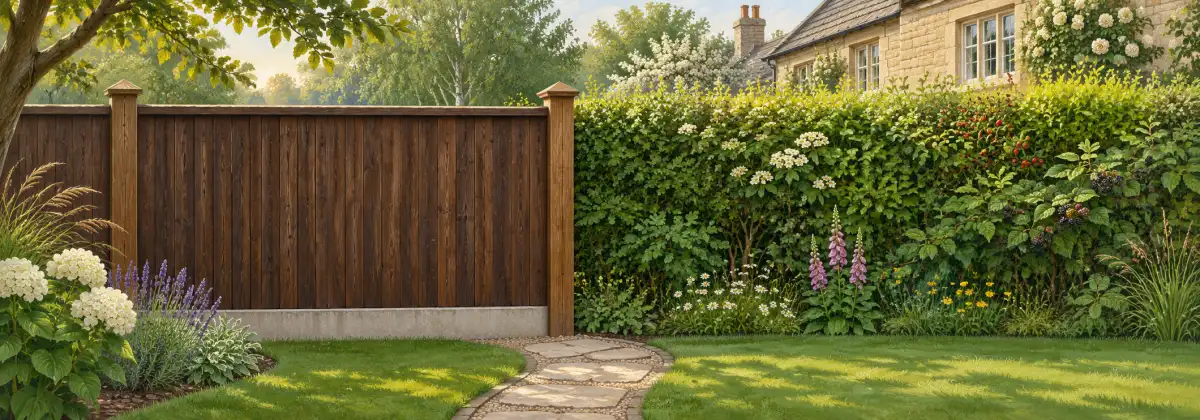
A fence gives you privacy and containment on the day it is built. A hedge gives you habitat, flowers, berries and a softer boundary, but it needs time, water and regular cutting. For most UK gardens the sensible answer is simple: choose a fence when certainty matters now, a hedge when wildlife and long-term character matter most, and both when you need privacy while planting grows.
Fence for instant screening, a dog boundary or a very exposed site. Hedge for habitat, flowers, berries and a wind-filtering living edge. Combine them for a new-build garden, an overlooked patio or a dog that cannot wait five years for plants to fill out.
The short answer for your garden
| Your priority | Best first choice | Why |
|---|---|---|
| Privacy this month | 1.8 m closeboard fence | Height and coverage are predictable from day one. |
| Wildlife and a softer view | Mixed native hedge | Flowers, fruit, shelter and soil-level connections improve as it matures. |
| Dog containment now | Fence, with planting outside | The fence does the containing while the hedge establishes. |
| Strong wind exposure | Well-posted fence or porous hedge | A solid sail needs sound posts. A hedge reduces wind speed gradually, not absolutely. |
| Front garden security | Low visible boundary plus planting | You keep sight lines while thorny plants add delay and deterrence. |
| Lowest long-term fuss | Fence with concrete or well-treated posts | It still needs inspection, but not annual growth management. |
Measure the boundary, check the highway relationship and read your deeds before choosing a material. A neighbour's fence, a covenant or a conservation-area restriction can matter more than the price per metre. The shed placement guide uses the same boundary checks for garden buildings.
What a fence and a hedge actually do
A fence is a fixed screen. Its height, gaps, posts and panels stay broadly the same until weather or maintenance changes them. That makes it good at immediate privacy, dog containment and keeping a clear line beside a path. Its weak points are concentrated: the post at ground level, the fixings and the panel's wind load.
A hedge is a living screen. It can be thin when planted, bare at the base, wider than expected or damaged by drought. In return it can flower, fruit, shelter insects and birds, and soften wind rather than stopping it abruptly. The best comparison is not fence versus hedge in the abstract. It is a new fence versus a young hedge, then a sound fence versus an established hedge ten years later.
Three questions settle most decisions. Do you need the privacy now? Can you water and weed for the first two summers? Is the line exposed to wind, a road, a dog or a neighbour's view? Answer those before comparing species.
Storms and wind
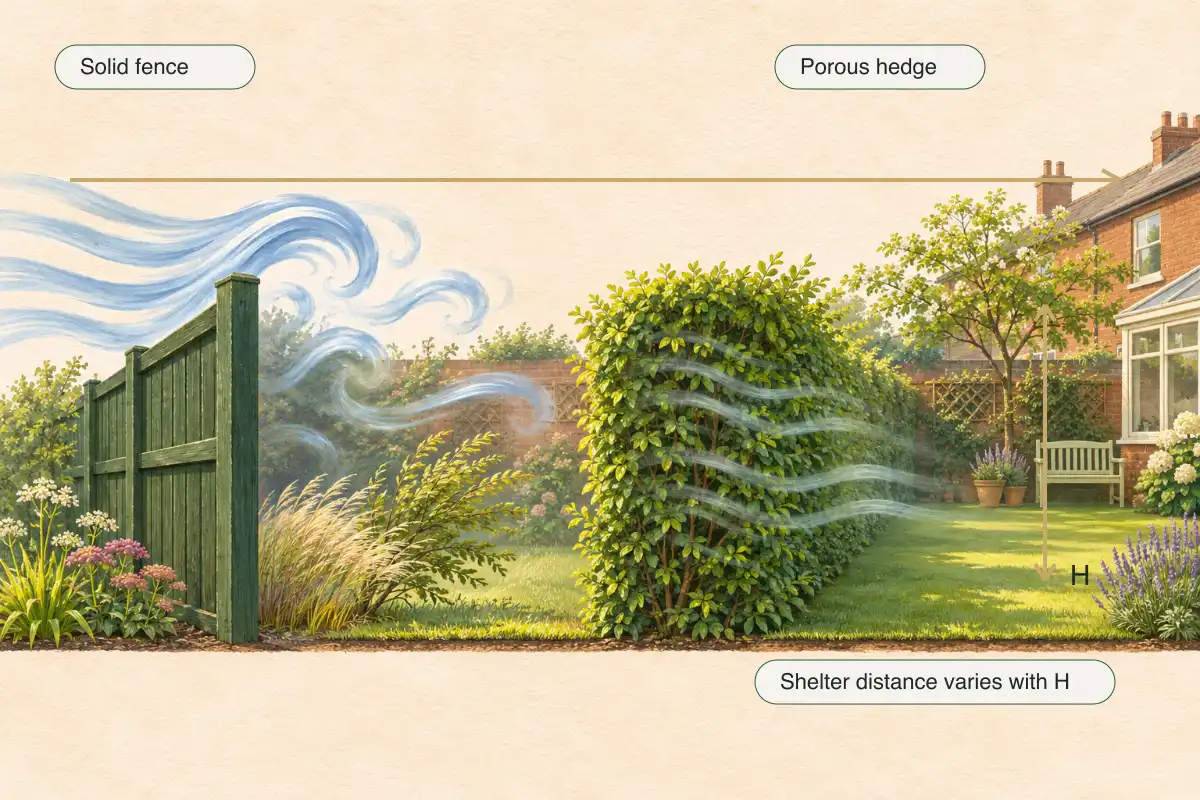
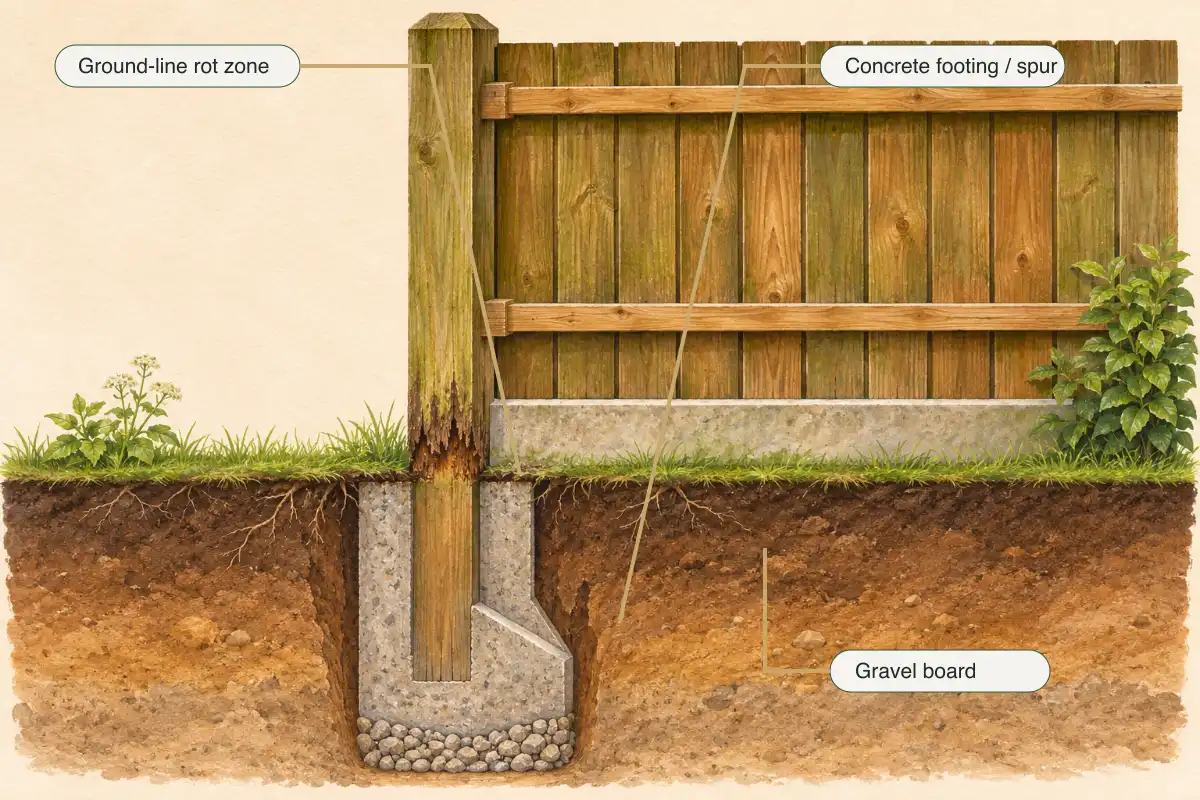
A solid panel behaves like a sail when wind reaches its face. Pressure travels through the boards into rails, fixings and posts, then into the ground. Rot at the ground line removes the post's strength exactly where the bending force is greatest. A fence can therefore look fine from the garden and still fail at its foot.
The Met Office recorded a 122 mph gust at Needles Old Battery during the 2021 to 2022 storm season, and winds over 69 mph were recorded widely across southern England. Those are weather observations, not design gusts for your garden. They show why a sound closeboard fence with properly set posts is a different object from a tired lap panel with shallow, wet posts.
A hedge is porous. Air slows as it passes through leaves and branches, so the pressure change is less abrupt. The useful shelter distance is often described using the hedge height H, but there is no single safe multiple for every garden. Porosity, height, length, gaps, wind direction and nearby buildings all change the result. Treat research ranges as orientation, not a specification. A dense, untrimmed hedge can still catch wind, and a young hedge is vulnerable to wind rock for its first two or three years.
| Fence type | Wind behaviour | Typical life | Typical installed cost per metre | Upkeep |
|---|---|---|---|---|
| Lap panel on timber posts | High panel loading, weakest point is often the post | Planning assumption: renew at year 15 | £55 to £95 | Inspect yearly, treat and repair as needed |
| Lap panel on concrete posts | Panels still catch wind, posts resist rot better | Depends on panel condition | £70 to £115 | Wash and inspect panels, renew fixings |
| Closeboard on timber posts | Heavy and repairable, needs strong posts | Planning assumption: renew at year 22 | £90 to £150 | Inspect timber, gravel board and rails |
| Closeboard on concrete posts | Stable posts, continuous boards still catch wind | Depends on board condition | £110 to £175 | Inspect boards and concrete slots |
| Slatted or louvred panel | Some porosity reduces pressure, privacy varies by angle | Product and treatment dependent | £120 to £220 | Clean gaps and maintain timber or coating |
| Steel mesh with planting | Low sail effect, plants provide later screening | Product and corrosion protection dependent | £65 to £140 | Train plants, check corrosion and ties |
For an exposed boundary, use shorter panel runs between substantial posts, keep timber out of standing water, and replace a cracked post before winter. Concrete posts avoid timber rot but do not make a solid panel windproof. Steel mesh can be the best structural middle ground when a hedge will eventually provide the screen. The timber treatment guide explains the same ground-line and end-grain discipline for a nearby shed.
Insurance is another practical limit. The Association of British Insurers says storm damage to fences, hedges and gates is generally not covered and that fences are excluded by most standard buildings policies because they are very susceptible to wind damage. Check your own wording before assuming a storm claim will pay for replacement.
How long each option lasts
Fence life is a maintenance and drainage result, not a number printed on a panel. Water at the ground line, untreated cut ends, loose fixings, ivy, soil piled against boards and repeated wind movement do more damage than age alone. Gravel boards lift the panels away from soil. Concrete or steel posts remove one rot risk, but the boards can still fail. Use a yearly garden-building maintenance checklist as a reminder to inspect the boundary too.
BS 8417 describes treated timber by use class, treatment penetration and a desired service life. The Wood Protection Association gives 15, 30 or 60 years as service-life choices for a specification. That is a desired service life for correctly specified timber in the stated use, not a promise that every garden fence will reach it. Ask for the treatment class and component use, particularly for posts in ground contact.
Hedges can outlive several fences, but only if they establish. Yew, holly, beech and hornbeam can form long-lived boundaries. Cherry laurel and Leyland cypress grow quickly, but they demand regular cutting and can become too large for a narrow garden. Box is a poor default where box blight or box tree caterpillar is present. Honey fungus, drought, waterlogging, browsing and root disturbance can kill a hedge in sections.
For a hedge, “life” means the time before renewal rather than a guarantee. A mixed native line may be gapped up for decades. An overgrown Leylandii row may need removal because it has outgrown the space long before the plants are biologically old.
Security and privacy
Security has three parts: deterrence, delay and visibility. A 1.8 m rear fence can slow casual entry and screen a patio. It is not an impenetrable wall. A thorny hedge can make a landing point unpleasant, but a hedge beside a climbable fence can also give an intruder cover. Keep gates locked, avoid hiding places beside doors and maintain sight lines at the front.
Secured by Design says: “Lower fences at the front of a property around 1 metre high are better than high fences as they allow for natural vision over and do not provide cover for someone hiding.” It adds that “At the rear and sides of a property taller fencing is recommended to prevent easy access; a minimum height of 1.8 metre is advised.” These are security recommendations, not universal legal limits. A tall solid front hedge may give privacy but can remove the view from your windows and the street.
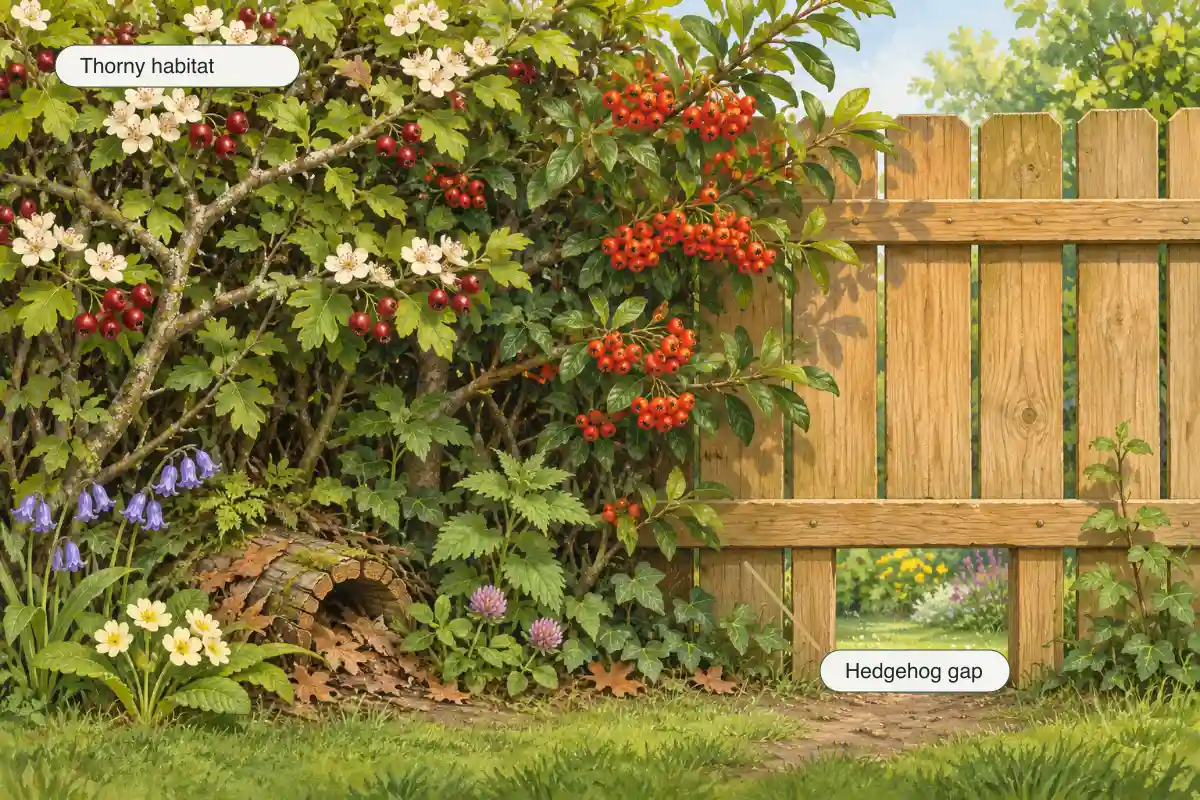
Hawthorn and blackthorn bring thorns, flowers and fruit. Holly gives evergreen cover and prickly leaves. Pyracantha and berberis are defensive but need careful handling and a site where their spread can be controlled. For dogs, Blue Cross advises choosing fence height and security for the individual dog and checking daily for holes or gaps if it is prone to escaping or digging. A hedge is not a reliable containment line while young, so use a sound fence or internal wire. Keep gaps small enough for the dog you own and avoid sharp projections at nose height.
Maintenance and cutting law
A fence needs a yearly walk-round, occasional treatment and a repair budget. The time depends on length, access and condition, so the cost model below uses an explicit £2 per metre per year allowance rather than pretending that a universal hours figure exists. A hedge needs watering and weeding while young, two to four cuts a year for a fast formal evergreen, and one cut every year or two for a wildlife-focused mixed native hedge. A contractor's bill depends on access, height and green-waste disposal.
The RSPB's current garden advice is precise: “The best way to help your garden birds is to not cut your hedges between March and September as this is when the possibility of birds nesting is very high. So, we recommend only cutting between 1 September and the end of February.” That stricter window is the one used here. The RSPB's grow-a-hedge advice gives the slightly different summary of avoiding March to August. Neither is a licence to cut an active nest. Under the Wildlife and Countryside Act 1981, intentionally damaging or destroying an active wild bird nest or its eggs is an offence. Look before cutting, stop if you find a nest and return later.
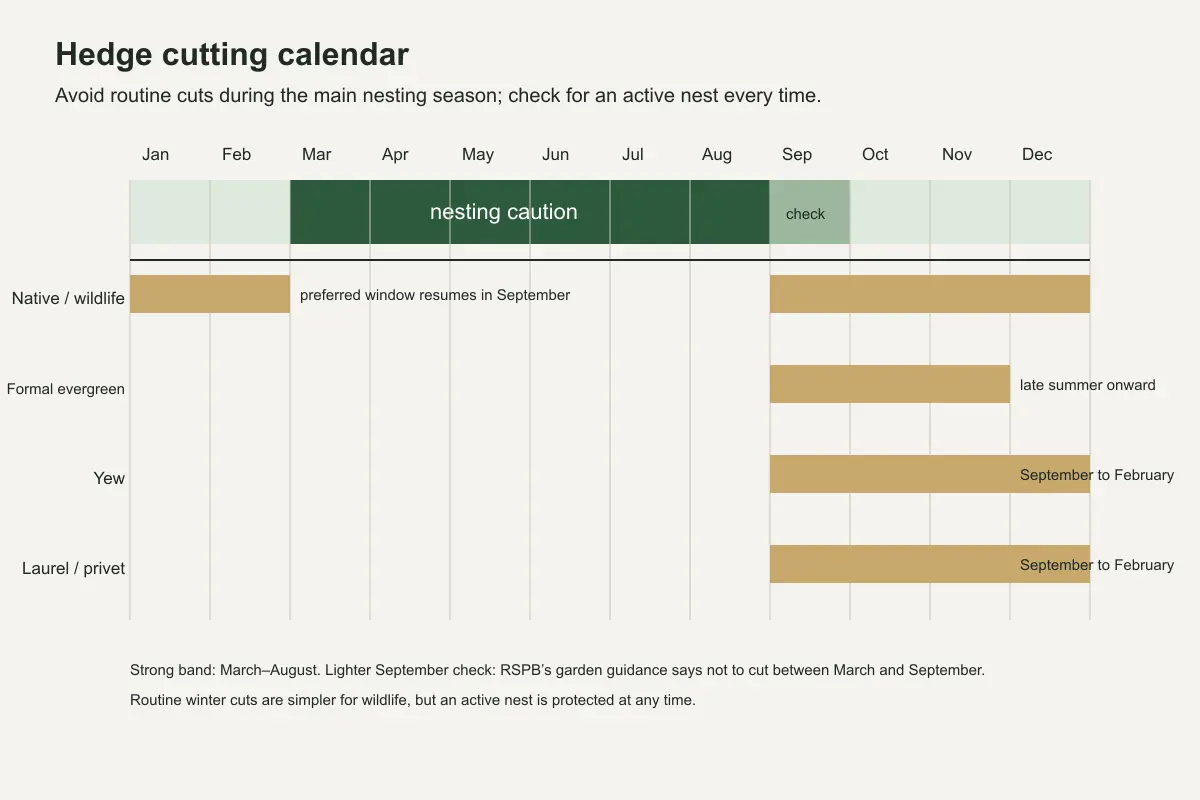
England's agricultural rule is separate. The Management of Hedgerows (England) Regulations 2024 prohibit cutting or trimming an important hedgerow on agricultural land from 1 March to 31 August, with exceptions for safety, disease and other specified reasons. The Regulations apply to hedgerows growing on land used for agriculture and expressly exclude a hedgerow within the curtilage of, or marking the boundary of the curtilage of, a dwelling house. That exclusion does not remove the active-nest protection.
For a hedge over a pavement or road, section 154 of the Highways Act 1980 lets the highway authority require an owner or occupier to cut back vegetation that overhangs or obstructs the highway. Keep branches and foliage clear of lamps, signs and sight lines at drives. A council can act where a hedge blocks visibility or makes the route unsafe, so safety work may be needed outside your preferred cutting month.
Cost per metre and cost over 25 years
Prices change quickly, so this model is a dated planning comparison, not a quote. It uses a 25 m boundary over 25 years. Job Prices lists lap panels on timber posts at £54 to £75/m and closeboard panels on concrete posts with gravel boards at £88 to £104/m, fitted; the model uses the midpoint of each range: £64.50/m and £96/m. The renewal points at year 15 for lap panels and year 22 for closeboard are planning assumptions, chosen to make replacement risk visible rather than promises of service life. The plant inputs use five 60 to 90 cm bare-root plants per metre at £1.25 each, or two 90 to 120 cm root-ball yews per metre at £40.13 each. RHS guidance gives 30 to 60 cm within-row spacing, so 50 cm is used for the root-ball case. DIY planting is £0 labour. Guards and mulch are £10/m, with a 10% establishment allowance. Gates, retaining walls, difficult access and planning work are excluded.
There are two hedge maintenance cases because ownership of the work changes the answer: DIY trimming is a £8/m/year time and green-waste allowance, while contractor trimming is a £18/m/year planning allowance derived from the published hourly and waste ranges in the Job Prices hedge-cutting guide. Fence annual inspection and minor repair is a £2/m/year working allowance. The model does not forecast inflation or assign a monetary value to privacy, habitat or your own time beyond those allowances.
| Option for 25 m | Initial lines | Renewal and upkeep lines | 25-year total |
|---|---|---|---|
| Lap panel fence | £1,612.50 initial | £1,612.50 renewal + £50 per year, £1,250 over 25 years + £250 disposal | £4,725 |
| Closeboard fence | £2,400 initial | £2,400 renewal + £50 per year, £1,250 over 25 years + £250 disposal | £6,300 |
| Bare-root hedge, DIY trim | £156.25 plants + £0 planting + £250 guards/mulch + £12.50 replacements | £200 per year, £5,000 over 25 years | £5,418.75 |
| Bare-root hedge, contractor trim | £156.25 plants + £0 planting + £250 guards/mulch + £12.50 replacements | £450 per year, £11,250 over 25 years | £11,668.75 |
| Root-ball yew, DIY trim | £2,006.50 plants + £0 planting + £250 guards/mulch + £160.52 replacements | £200 per year, £5,000 over 25 years | £7,417.02 |
| Root-ball yew, contractor trim | £2,006.50 plants + £0 planting + £250 guards/mulch + £160.52 replacements | £450 per year, £11,250 over 25 years | £13,667.02 |
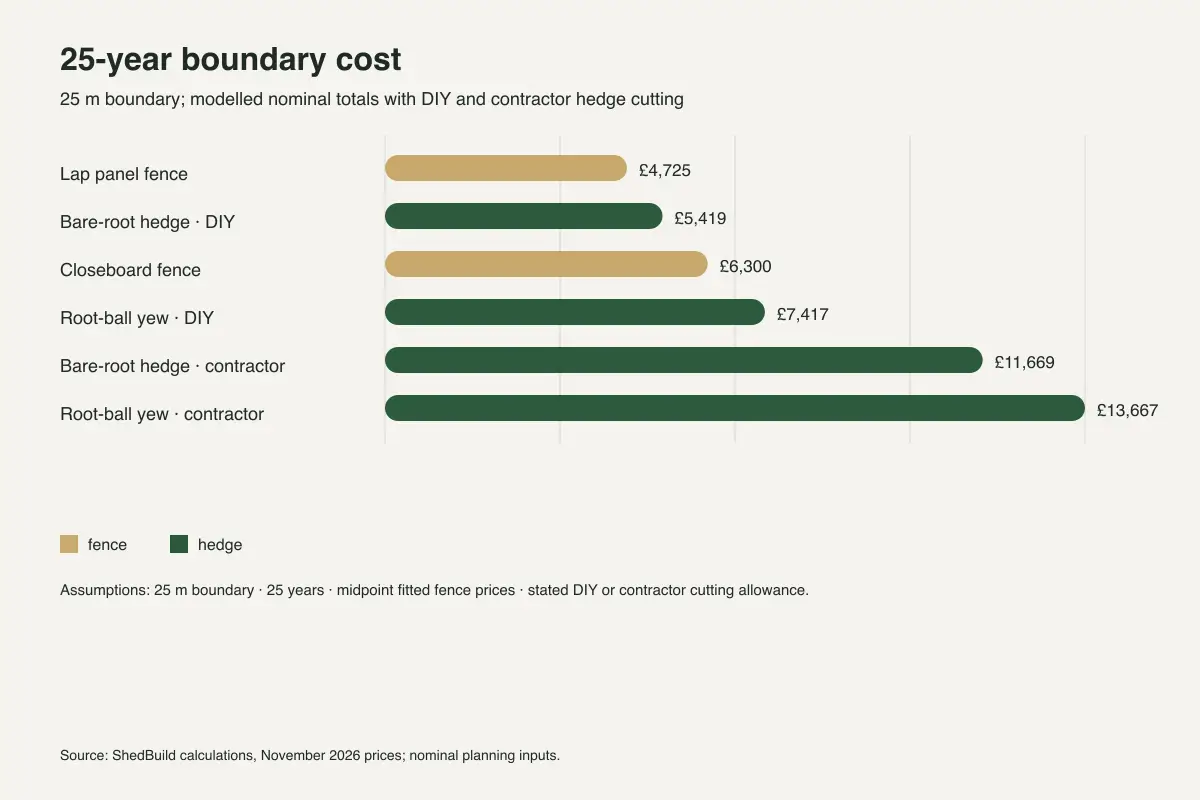
The arithmetic is visible line by line in the claims register. A cheap bare-root hedge can be the lowest cash-cost option if you do the cutting yourself. Contractor cutting reverses that result, which is why the maintenance choice must be stated instead of hidden inside a single “hedge cost”.
How long to privacy
Bare-root planting is practical from November to March while the soil is workable. In late November, order healthy 60 to 90 cm plants, keep roots damp and covered, plant into a weed-free trench, firm the soil, water thoroughly and add mulch. A double staggered row at about 30 cm spacing gives a dense native hedge. Water through the first summer during dry spells, keep grass away from the base for at least two seasons and use guards where dogs or rabbits browse.
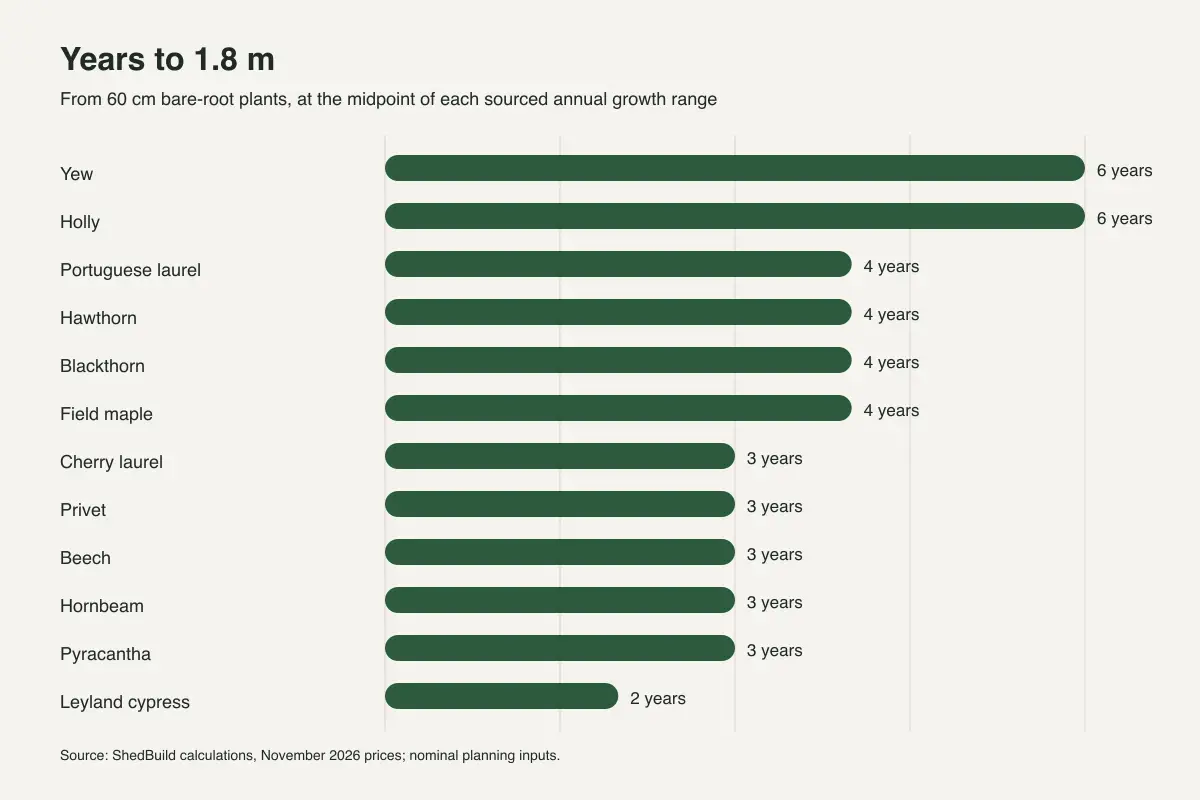
Root-ball or container plants give more height on day one, but the root system still needs to establish. The numbers below are calculations from a 60 cm bare-root starting height or a 1.2 m root-ball starting height, using a cautious central annual increment. They show the arithmetic to 1.8 m, not guaranteed screening. Trimming for density can make a hedge look private later than its top reaches the target.
| Species | Evergreen | Sourced growth range | Central increment | Years from 60 cm to 1.8 m | Mature width | Security and wildlife | Site and cutting notes | Typical cost per metre |
|---|---|---|---|---|---|---|---|---|
| Yew | Yes | 15 to 30 cm | 22.5 cm | 6 | 1.5 m | Dense, long-lived, berries for birds | Shade tolerant, toxic if eaten, one formal cut | £32 / £95 |
| Holly | Yes | 15 to 30 cm | 22.5 cm | 6 | 2 m | Prickly, nesting cover and berries | Shade tolerant, one or two formal cuts | £28 / £78 |
| Cherry laurel | Yes | 30 to 60 cm | 45 cm | 3 | 2 m | Dense screen, limited native food value | Most soils, two cuts, toxic foliage | £26 / £65 |
| Portuguese laurel | Yes | 20 to 40 cm | 30 cm | 4 | 2 m | Dense cover, flowers for insects | Formal hedge, one or two cuts | £30 / £72 |
| Privet | Semi-evergreen | 30 to 60 cm | 45 cm | 3 | 1.5 m | Dense and bird-friendly when flowering | Most soils, two or three cuts | £18 / £55 |
| Leyland cypress | Yes | 60 to 90 cm | 75 cm | 2 | 2.5 m | Fast screen, limited habitat when tightly clipped | Needs space, two cuts, avoid old wood | £20 / £58 |
| Beech | Deciduous | 30 to 60 cm | 45 cm | 3 | 2 m | Dense winter leaves, nuts and cover | Well-drained soil, one late-summer cut | £17 / £52 |
| Hornbeam | Deciduous | 30 to 60 cm | 45 cm | 3 | 2 m | Good cover and catkins | Tolerates heavier soil, one cut | £18 / £54 |
| Hawthorn | Deciduous | 20 to 40 cm | 30 cm | 4 | 2 m | Strong thorn, blossom, haws and nesting value | Most soils, one winter cut | £14 / £48 |
| Blackthorn | Deciduous | 20 to 40 cm | 30 cm | 4 | 2 m | Very thorny, early blossom and sloes | Spreads by suckers, one winter cut | £15 / £50 |
| Field maple | Deciduous | 20 to 40 cm | 30 cm | 4 | 2 m | Good native cover and autumn colour | Tolerates clay, one or two cuts | £16 / £50 |
| Pyracantha | Evergreen | 30 to 60 cm | 45 cm | 3 | 2 m | Thorns, blossom and berries | Train to wires, one or two cuts | £30 / £70 |
The law in England, Wales, Scotland and Northern Ireland
There is no single UK boundary rule. Fence height, conservation controls, high-hedge complaints and permitted development are separate questions. A legal maximum is not a neighbour's automatic right to demand a preferred hedge height.
| Nation | Fence and planning route | High hedge route | Practical check |
|---|---|---|---|
| England | Usually permission is needed over 1 m when adjacent to a highway used by vehicular traffic, or over 2 m elsewhere, under GPDO Class A. Class E puts a 2.5 m overall height limit on an outbuilding within 2 m of the curtilage boundary. | Anti-social Behaviour Act 2003 Part 8. The council where the hedge stands decides a qualifying complaint after reasonable attempts to settle it. | Check conservation area, listed-building curtilage, covenants and the council fee. |
| Wales | GOV.WALES gives the same 1 m next to a vehicular highway and 2 m elsewhere thresholds, subject to listed-building, Article 4 and planning-condition controls. | Anti-social Behaviour Act 2003 Part 8. The maximum Welsh fee is £320, though a council decides whether to charge. | Use the Welsh rules and check the local authority. |
| Scotland | Class 3E normally allows up to 2 m, or 1 m where it fronts a road or extends forward of the nearest principal elevation. Conservation areas and listed curtilage are excluded. | High Hedges (Scotland) Act 2013. The test is two or more trees or shrubs that rise above 2 m and affect a domestic property. Deciduous hedges can count under the 2019 revised guidance. | Check the council's fee and whether the road-facing test applies. |
| Northern Ireland | There is no single England-style summary on nidirect: permitted development, designated-area controls and roadside consent can apply. Ask the local planning office before building. | High Hedges Act (Northern Ireland) 2011. A qualifying high hedge is a barrier to light formed predominantly by two or more evergreens over 2 m; the council may set a fee. | Check nidirect, the council and DfI Roads for a roadside boundary. |
In England, the current revised GPDO wording is a height limit, not a setback. If any part of a shed is within 2 m of the curtilage boundary, the permitted-development height limit is 2.5 m. The fence rule is separate: 1 m next to a highway and 2 m in other cases are the usual Class A thresholds, subject to the full limitations and any local restriction.
What counts as a high hedge
In England and Wales, the Part 8 definition is a barrier to light or access formed wholly or predominantly by a line of two or more evergreen or semi-evergreen trees or shrubs rising more than 2 m above ground level. Scotland's 2019 revised guidance says the Act test is two or more trees or shrubs, and confirms that a deciduous hedge can count. Northern Ireland uses its own Act. Height alone does not make a hedge unlawful. The complaint route is for an adverse effect on the reasonable enjoyment of a domestic property, after reasonable attempts to settle the dispute.
Councils set fees locally. For real examples checked on 28 November 2026, Birmingham asks £350, Stockport asks £675, and West Norfolk asks £301.90. Wales has a statutory maximum fee of £320; Scotland and Northern Ireland allow the relevant local authority or council to set a fee. Leyland cypress is a fast-growing, wide conifer that needs regular control. Keep the guide's growth, width and maintenance facts in view rather than treating complaint frequency as a legal fact.
Boundaries and neighbours
There is no rule that the left-hand fence belongs to the left-hand house. There is no universal “good side faces out” rule either. HM Land Registry says title plans usually show general boundaries, not the exact line, and a T mark is evidence only when the deed or transfer gives it meaning. A fence can be near the legal boundary without proving ownership.
Before removing a shared-looking fence, read the transfer, ask the neighbour and take photographs. A replacement on the same line can still be a dispute if the old feature was jointly maintained. The GOV.UK Party Wall explanatory booklet says a party fence wall “does not include such things as wooden fences or hedges”. That does not remove the separate rules for a masonry wall or excavation near a neighbour's foundations, so use the official guidance or legal advice for a specific project. If the boundary also hides a shed, the shed screening guide covers planting and access without fixing anything to the fence.
For a T-shaped mark, start with the deed wording, not the direction of the T. For a boundary hedge, agree who cuts each face and who owns the plants. A written note about access and clippings is often more useful than an argument over which side looks best.
Wildlife and the environment
A hedge can provide flowers, fruit, shelter and a route for small animals. Native mixes usually offer a broader seasonal range than a tightly clipped single-species screen, but a fence with a planted border can still support wildlife. Do not remove mature cover without checking for nesting birds, and leave some leaf litter where it will not block drains.
Hedgehog Street recommends a 13 cm by 13 cm passage at the base of fences so hedgehogs can move between gardens. Put the opening away from a road, keep it clear and tell the next-door garden owner. It is a small detail with more value than claiming a hedge is automatically wildlife-friendly.
The Hedgerows Regulations 1997 protect important hedgerows in specified countryside settings, but they say they do not apply to a hedgerow within the curtilage of, or marking the boundary of the curtilage of, a dwelling house. The 2024 England management regulations likewise exclude a dwelling-house curtilage from their agricultural hedgerow scope. Wildlife protection at an active nest still applies.
Noise and overlooking
A hedge usually changes the sound of a road less than people expect. Leaves and branches scatter some higher frequencies, but a narrow hedge is not a soundproof wall. A wide, tall and dense hedge can help psychologically by hiding the road and adding natural sound, while a continuous solid barrier is normally better for immediate interception. The strongest practical combination is a well-built fence with planting in front, provided the fence does not create an unsafe wind sail.
For overlooking, height and continuity matter more than species name. A deciduous hedge can give excellent summer privacy and lose much of it in winter. Evergreen plants give year-round screening but often demand more cutting and can become large. Choose the view you need to block, then measure the mature width before planting.
The middle ground
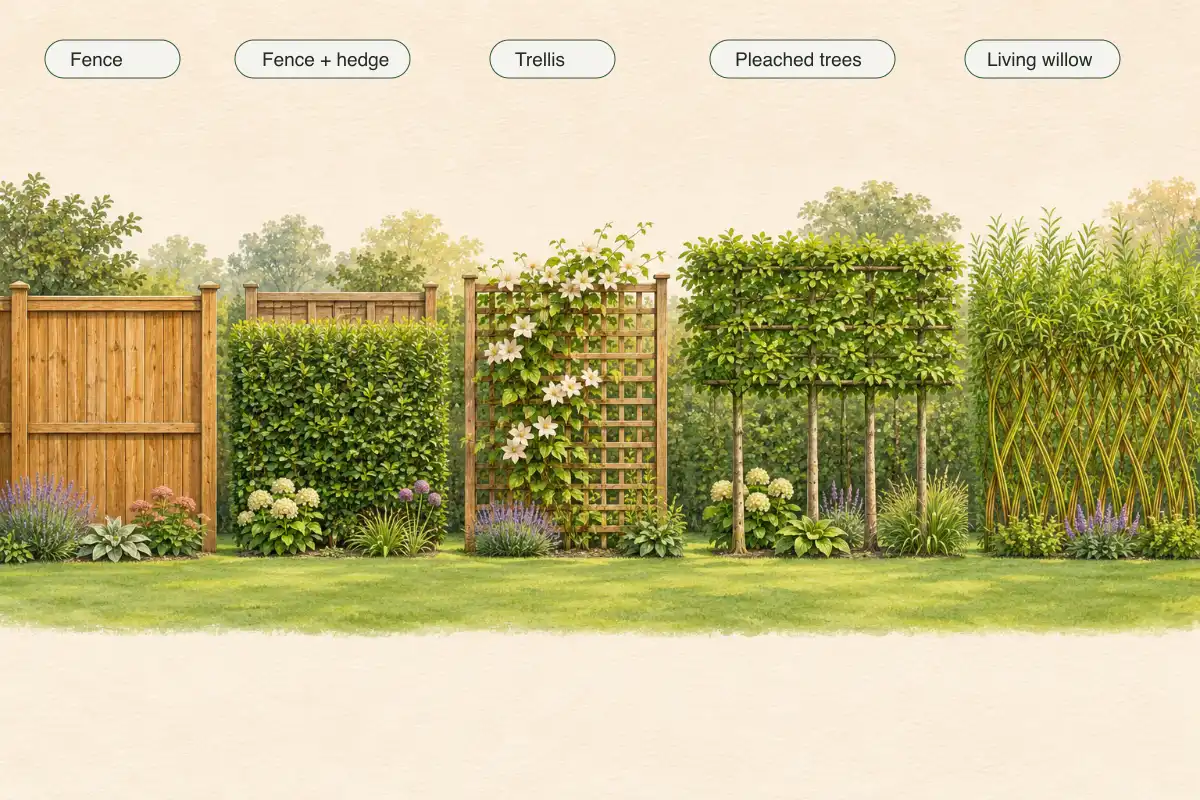
- Fence plus hedge. Put the fence on the containment line and plant on your side. The hedge gains shelter while the fence provides immediate privacy.
- Trellis topper. Add height and climbers without making a full solid panel, but check the total height and wind load.
- Pleached trees. Use trained stems above a lower fence where you need privacy at window height without a deep hedge.
- Living willow. It establishes quickly in suitable damp soil, but it needs training and is not a substitute for a secure dog boundary.
- Stock fence or internal wire. Keep dogs in while a hedge grows, then retain the wire if the planting will never be reliably dense at the base.
For a front boundary, a low fence, a visible gate and thorny planting set back from the pavement usually give a better balance than a tall wall of evergreen. For a rear boundary, plant the hedge where its mature width will not consume the path or shade a neighbour's garden. If a shed shares the view, compare this with the site's shed security and lighting guide before creating a dark, hidden corner.
A shed beside the boundary
England's current Class E rule does not require a shed to be 2 m from the boundary. It says that if any part of the building is within 2 m of the curtilage boundary, the permitted-development height limit is 2.5 m. A shed farther away can still fail another limitation, and a listed building, conservation area, covenant or planning condition can change the answer.
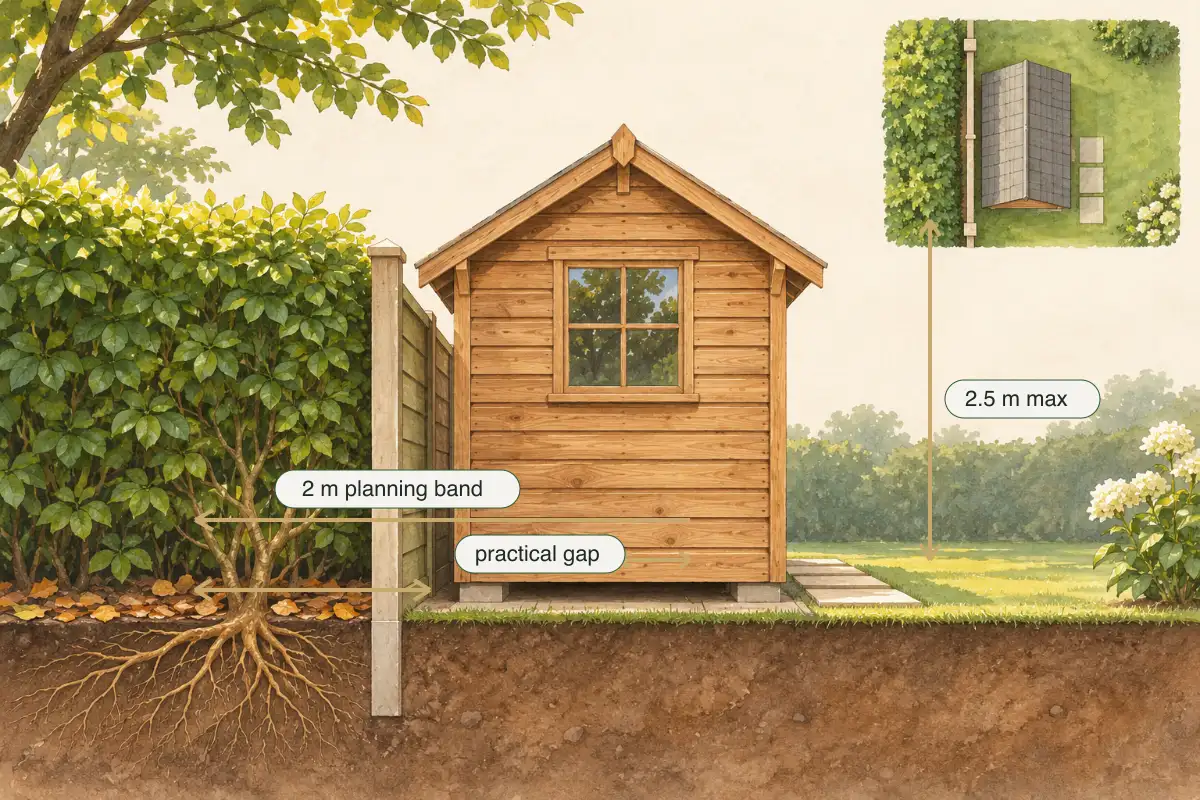
Leave enough room to paint the back wall, inspect the roof edge and clear leaves from gutters. A narrow gap that traps wet leaves against timber can create damp even when the shed is technically allowed. Keep hedge roots and branches off the wall, maintain airflow below the floor and never fix a shed to a fence that may move independently. For condensation, use the shed ventilation guide and the guide to stopping shed condensation.
Plan the base before the boundary. The waterproofing guide covers the roof, walls and floor, while the shed planning guide covers the wider permission questions. The shed foundation guide helps you keep the base level and clear of wet soil. If roots, access or a neighbour's fence make the proposed line tight, move the building before ordering it.
Decision table and verdict
| Choose a fence if | Choose a hedge if | Do both if |
|---|---|---|
| You need privacy or dog containment now, have little planting space, or want a clear predictable height. | You can wait for growth, will water and weed, and value flowers, fruit, habitat and a softer wind break. | You need privacy now but want a living boundary later, or the site is windy and a porous planted edge will help. |
| You prefer annual inspection and occasional treatment to regular cutting and green waste. | You want to accept seasonal change and prune to keep the base dense. | You want the fence to carry security while the hedge becomes the visual boundary. |
Our default for a typical new UK garden is a properly posted fence plus a mixed hedge planted inside it, with a 13 cm by 13 cm wildlife passage. It costs more at the start and takes more space, but it solves the two problems that make single-option choices frustrating: you get privacy and containment now, then habitat and a softer boundary later.
Before ordering, measure the line, mark any highway, check the title documents and covenants, inspect soil and wind exposure, price the 25-year option, and agree access with the neighbour. The right boundary is the one you can maintain at its mature size, not the one that looks cheapest on delivery day.
Frequently asked questions
Is a hedge better than a fence in strong winds?
How long does a hedge take to reach 1.8 metres?
Can I cut my garden hedge between March and September?
What is cheaper over 25 years, a fence or a hedge?
How close can a shed be to a boundary in England?
Planning a shed by the boundary?
Design a timber shed to your exact size with our free builder and get a complete materials list, cutting plan and cost estimate.
Open the Shed BuilderReady-made sheds worth a look
Rather buy than build? These sheds come delivered as panels, ready to assemble.
 Shire Value Overlap Apex Shed 8x6
 Yardmaster Emerald Deluxe 65GEYZ Metal Shed 1.86 x 1.25m
 Mercia Value Overlap Pent Shed 10x6
Affiliate links. We may earn a commission at no extra cost to you.