Shed Installation Cost: How Much to Have a Shed Put Up
Having a shed put up costs about £100 to £180 for a 6x4 and £150 to £300 for an 8x6. See what fitting includes, regional prices and how to check a fitter.
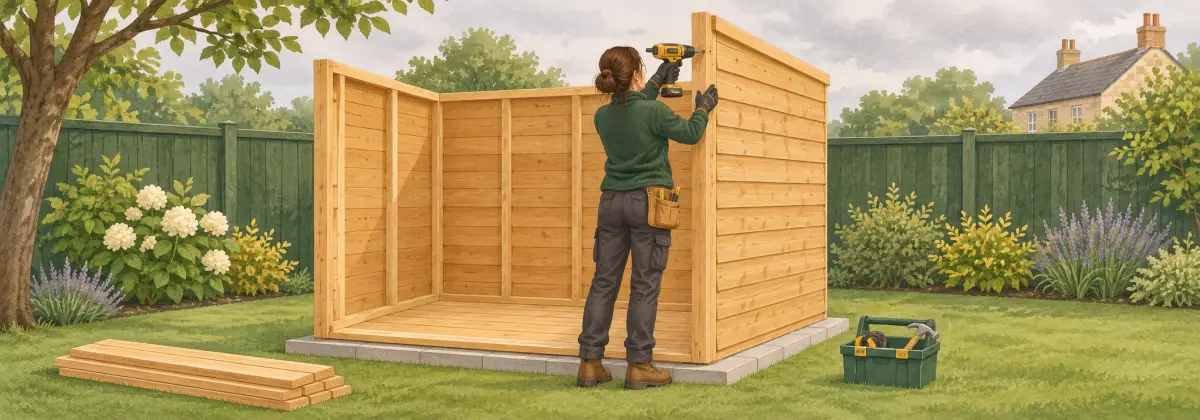
If you have bought a shed but do not want to put it up yourself, a fitter can usually assemble a small flat-pack building in a few hours. For a typical 6 x 4 ft timber shed, allow about £100 to £180 for fitting labour. An 8 x 6 ft shed is more often £150 to £300, while a 10 x 8 ft building can be £220 to £400. Those are planning figures for a ready base, not a promise or a complete shed price.
Ask for three written quotes that separate the shed, base, fitting, removal and extras. Send photos of access and the base before anyone prices the job. A good fitter will ask questions, show insurance and explain who is responsible if panels are missing or damaged.
How much does it cost to put up a shed
Published UK cost guides agree on the broad shape: a small, supplied kit is usually a low hundreds labour job; larger or heavier buildings take longer; and a base, old shed, treatment, electrics or awkward access can change the quote substantially. The table below is a sensible starting point for November 2026. It is fitting labour only, with a level base already in place.
Think of the first price as the cost of putting the supplied parts together, not the cost of making an empty patch of garden ready. The difference is why two honest quotes can look far apart. Ask each fitter to show the labour line and every site allowance separately.
The ranges above come from published UK cost guides checked in November 2026, which broadly agree for the common sizes; one guide puts the medium and large sizes higher. Where you live matters too. One November 2026 guide gives these typical ranges for having a shed assembled, by region:
| Region | Typical cost per shed |
|---|---|
| London | £130 to £460 |
| South East | £110 to £390 |
| East of England | £105 to £370 |
| South West | £100 to £350 |
| Midlands | £95 to £330 |
| Scotland | £95 to £330 |
| North of England | £90 to £320 |
| Wales | £90 to £320 |
| Northern Ireland | £85 to £300 |
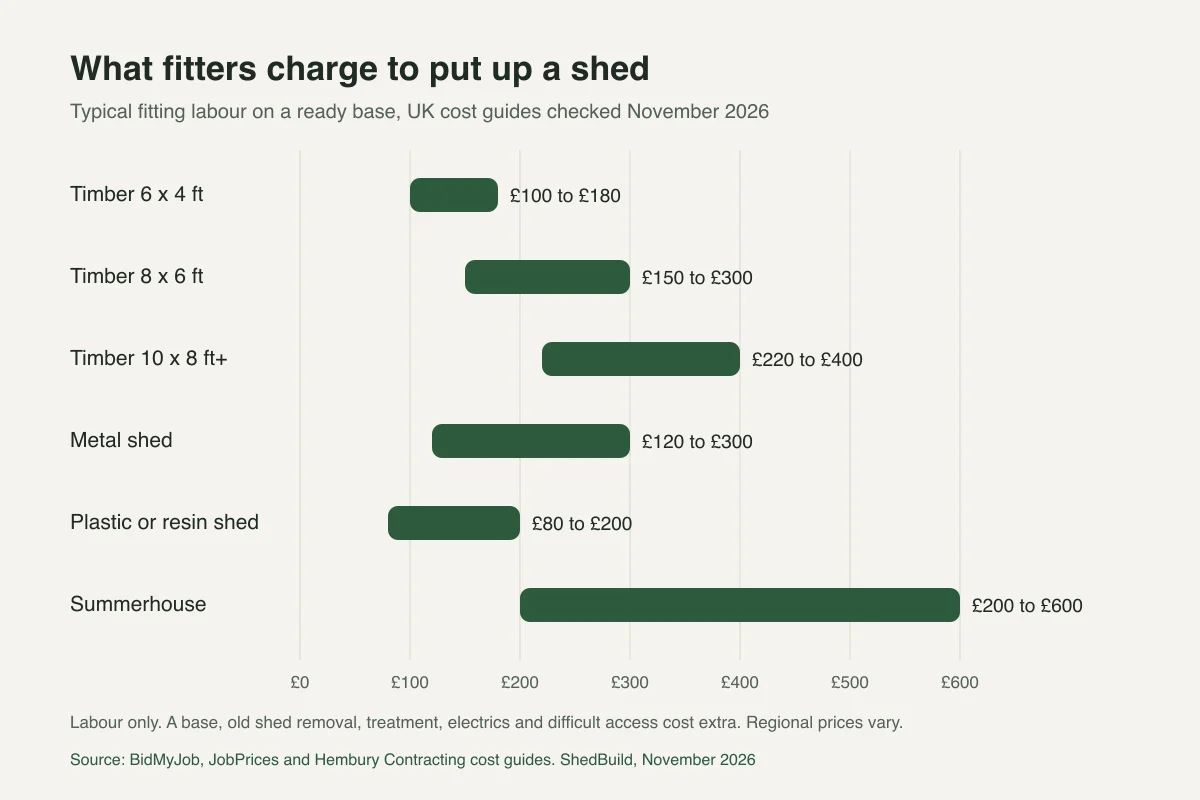
| Building | Typical fitting labour | Likely time | What changes it |
|---|---|---|---|
| Timber flat-pack 6 x 4 ft | £100 to £180 | About half a day | Panel condition, door adjustment and distance from the van |
| Timber flat-pack 8 x 6 ft | £150 to £300 | 3 to 5 hours | Two-person handling, roof detail and access |
| Timber 10 x 8 ft or larger | £220 to £400 | 5 to 8 hours | Weight, double doors, windows, partitions and site preparation |
| Metal shed | £120 to £300 | Varies by kit | Number of fixings, sharp edges and anchoring |
| Plastic or resin shed | £80 to £200 | Varies by kit | A proprietary base or extra anchoring |
| Summerhouse | £200 to £600 | Often a full day or more | Glazing, doors, roof covering and finishing; log cabins are usually quoted individually |
Metal and plastic sheds can look quicker because the panels are light, but they still need a square, level base and careful assembly. A metal kit may have many fixings and sharp edges. A plastic building may need a proprietary base or extra anchoring. Ask the fitter to price your exact model rather than assuming that the footprint tells the whole story.
Day rates are less useful than a fixed scope for a small shed. For larger buildings, a two-person team may quote a day rate or a fixed price with a provisional allowance. Confirm whether VAT is included, whether the fitter supplies fixings, and whether the price includes a final level and door check.
What is included and what costs extra
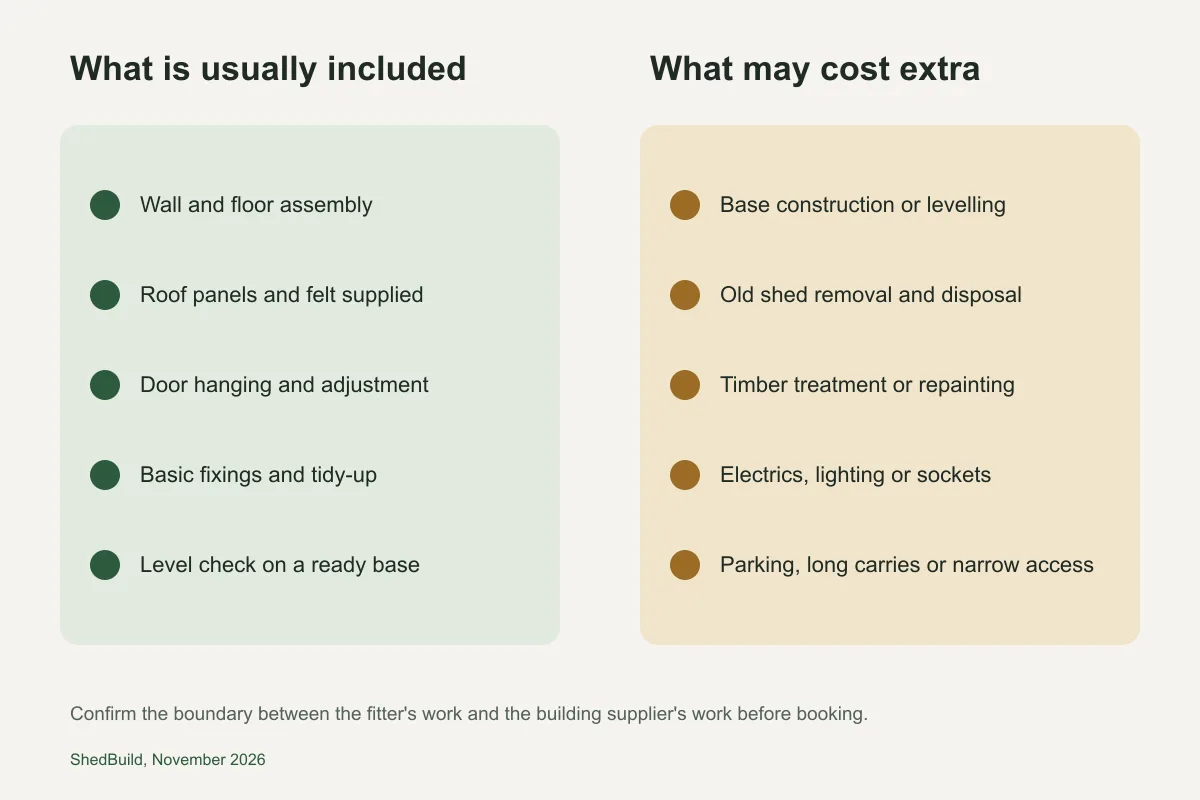
Normal assembly of a supplied timber kit often means building the floor and wall panels, fitting the roof, applying supplied felt or covering, hanging the door and leaving the area reasonably tidy. It does not automatically mean digging, levelling, building the base, moving a fence or treating the timber. Some suppliers include bearers or a base system, while others leave those parts to you.
- The base. A shed should sit on a firm, level base. Price a concrete, paving, timber or plastic base separately and use our shed base calculator before you compare fitting quotes. Our guide to building a shed foundation explains the practical choices.
- Removal. Dismantling an old shed, carrying it through the house or garden, loading a van and paying disposal fees can add more than the new assembly. Ask whether reusable timber is left for you and whether waste is licensed.
- Finishing. Preservative, paint, additional felt, trims, guttering and door furniture may be optional. A treated panel is not the same as a finished colour coat.
- Services. An electrician should quote for any new circuit, socket or lighting. Use the shed electrical installation guide for the questions to ask.
- Access. A narrow alley, steps, a long carry, parking restrictions or a building that must be passed through the house can require more people and time. Photograph the route and measure its narrowest point.
Retailer fitting, independent fitter or DIY
| Route | Good for | Watch for |
|---|---|---|
| Fitting arranged with the building purchase | One point of contact and a process designed around that model | Partner scope, waiting time, base exclusions and what happens when a panel is wrong |
| Independent shed fitter or builder | Flexible work, local knowledge, removal, repairs and mixed building types | You must check insurance, references, written scope and who supplies materials |
| DIY with a helper | Saving labour on an accessible kit and learning how the building works | Time, lifting, levelling, roof safety, missing tools and the cost of fixing a rushed assembly |
Some large retailers offer fitting through a partner. That can be convenient, but it is still worth asking who you contract with, who returns to fix a problem and whether the base is included. An independent fitter may be better for an old shed, a difficult garden, a bespoke building or a job that combines removal and assembly.
DIY is realistic for a small kit if you have a level base, two people for lifting, a dry weather window and time to read the instructions. The saving disappears if you need to buy tools, take time off work or repair a leaking roof. Do not lift large panels alone, and do not work on a roof in wet or windy weather.
How to find and check a fitter
Search for a shed fitter, shed erector, garden building installer or local builder, then compare evidence rather than adjectives. Ask for public liability insurance, recent photos of similar work and two or three references. Insurance does not prove workmanship, but it is a sensible basic check. Look for reviews that mention punctuality, care with property, doors that work and how problems were handled.
Trading Standards approved trader schemes, often called Buy With Confidence schemes, can be another place to check a business where your local authority participates. Treat membership as one check, not a substitute for a quote and references. Police advice on doorstep crime is consistent: do not accept pressure from an unexpected caller, do not pay cash on the spot, and do not let someone take you to a bank. A genuine fitter will allow time to compare quotes.
Ask who is responsible for damaged panels, missing parts and changes caused by an uneven base. Get the answer in writing. A quote should say the exact building size and type, whether the shed is supplied by you or the fitter, what is included, what is excluded, the start window, expected duration, payment stages, VAT, disposal and the process for extra work. A quote is more useful than a vague estimate, because it sets an agreed scope.
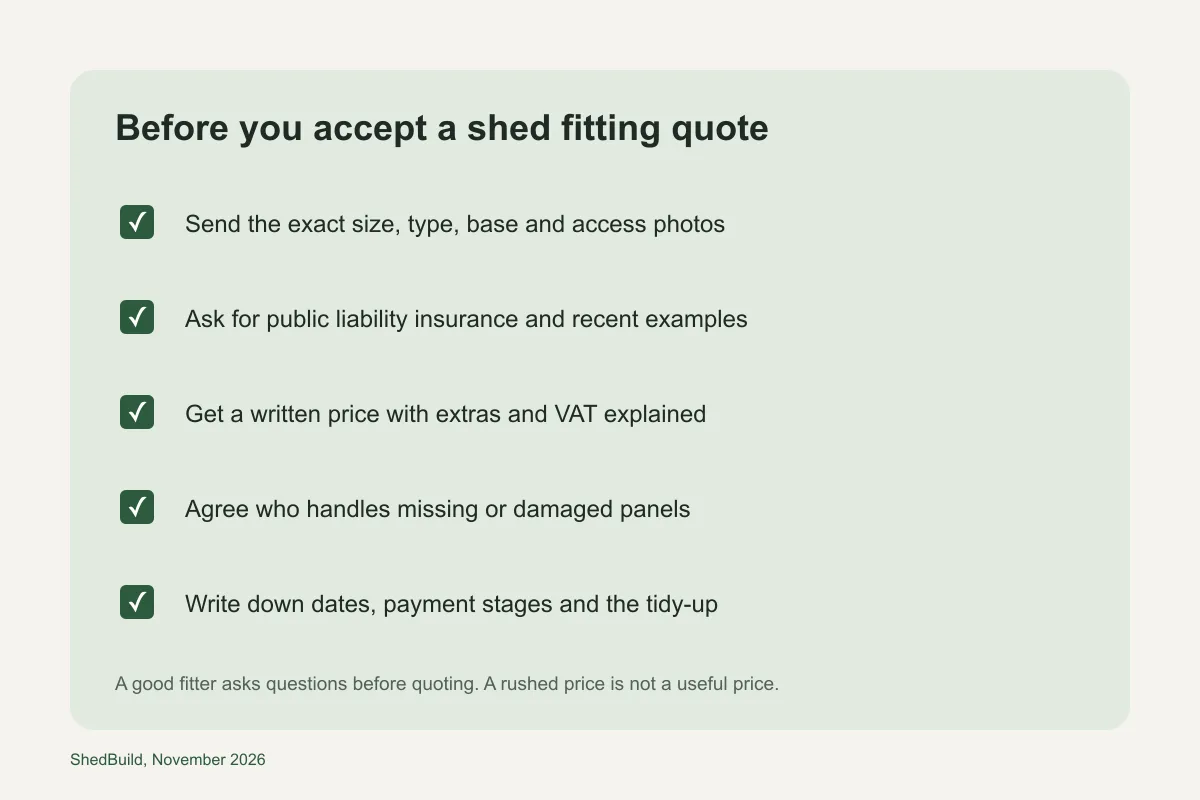
The quote checklist you can copy
Copy this into an email and fill in the blanks.
- Building: size, material, model and whether it arrives as panels or a flat pack.
- Site: base type, level condition, access width, steps, distance from parking and photos.
- Extra work: old shed removal, disposal, base work, felt, treatment, guttering, anchoring or electrics.
- Scope: assembly, door and window adjustment, roof covering, tidy-up and protection of paths or lawns.
- Paperwork: public liability insurance, written price, VAT, start window, duration, payment stages and aftercare.
- Problems: who reports missing parts, who pays for return visits and what counts as a client-supplied defect.
Give every fitter the same information. That makes price differences easier to understand. The cheapest quote may exclude the base, disposal or a long carry, while the highest may include a team and a faster date. Ask each person to state the assumptions.
If you would prefer a female fitter
Some people prefer a female fitter or tradesperson because they feel more comfortable with a woman working at home, because they live alone, or simply because that is their preference. You do not need to justify it. Exact searches for a female shed fitter are still sparse, but searches for a female carpenter, joiner, handyman, builder or tradeswoman are much broader. Ask local women in trade networks, community groups and reputable directories, and search for the wider skills that a shed job needs.
The supply is small. An ONS response says many individual women-in-trade estimates are suppressed because the numbers are small, so we should not invent a precise count of women carpenters or joiners. A UK government construction assessment reported women were 15% of construction employment in 2024. Consumer research also suggests a real preference: a 2018 OnePoll survey of 2,000 UK homeowners for the Federation of Master Builders reported 30% would feel more positive hiring a female builder or tradesperson, rising to 35% among women. Rated People's 2022 report said 46% would definitely hire a tradeswoman and 29% of women would feel safer doing so. These are broad home-improvement surveys, not a promise that a female shed fitter is available locally.
Use the same practical safety steps with any trade. Book an appointment, check identity and insurance, tell someone when the visit is due, keep valuables out of sight, and use a doorbell or phone contact if that helps you feel in control. You can ask for a written quote without inviting anyone inside. If a caller pressures you for immediate work or money, end the conversation. Many women also build sheds themselves, and our shed builder and other DIY guides can help you decide whether to do part of the job.
How long it takes and when to book
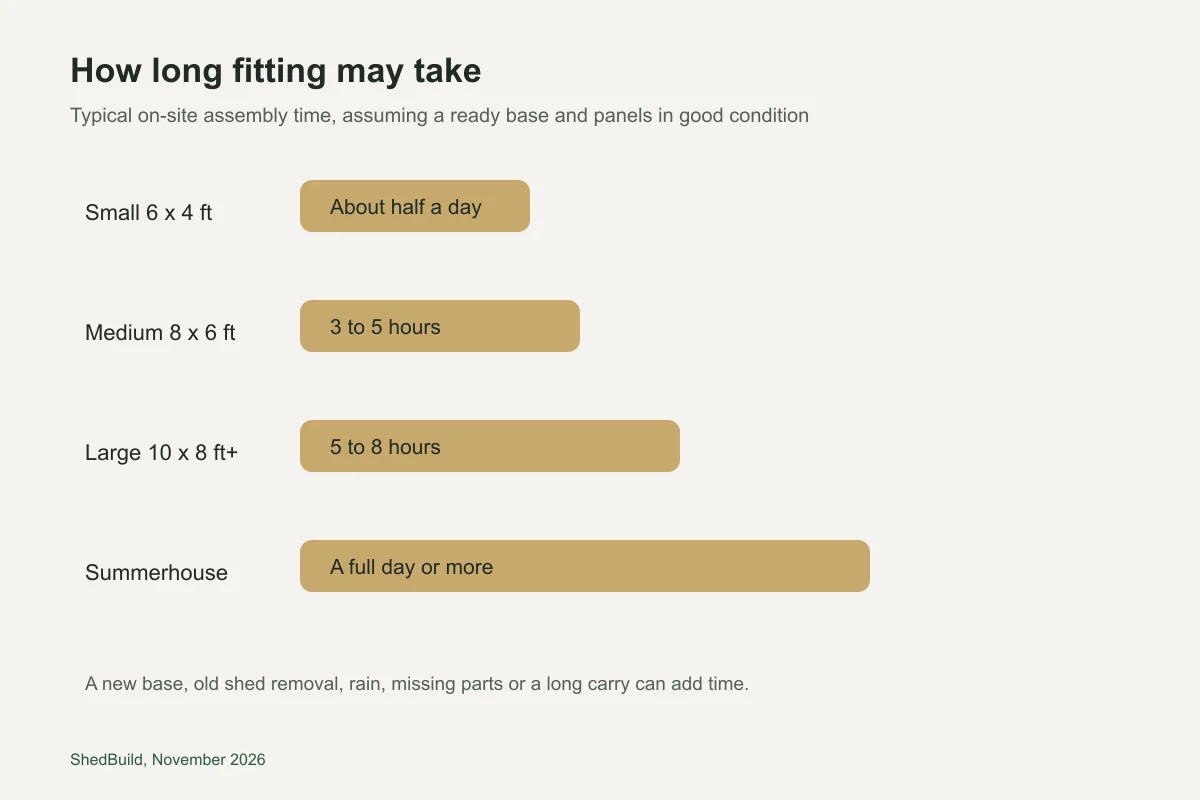
For a small timber kit, allow half a day. A medium shed is often a half to full day, while a large shed can occupy most of a day or more. A log cabin or summerhouse may take one to two days once the floor, thicker walls, windows, doors and roof are included. Removal, weather, missing parts and base work are separate time risks.
Book ahead for dry spring and summer weekends, when fitters and building suppliers are busiest. Autumn and winter can have better availability, but wet ground, short daylight and wind make outdoor assembly less predictable. Ask for a date window rather than a promise if the work depends on delivery. Before anyone quotes, be ready with the size, type, access, parking, base, old shed removal and where the panels can be stored safely.
Prepare the site before the fitting day
The best way to avoid a wasted visit is to make the site easy to understand. Photograph the garden from the street, the parking space, the route to the base and the base itself. Measure gates, alleyways, steps and any doorway the panels must pass through. Tell the fitter about low branches, soft ground, shared paths, restricted parking and the distance from the road. A professional may still want to visit, but these details help them bring the right number of people and the right equipment.
Have the base finished, level and accessible before the shed arrives unless the quote explicitly includes it. The base should be large enough for the building, but it should not leave timber sitting in standing water. Clear toys, pots, washing lines and garden furniture from the route. Do not stack panels where rain can soak them or where they block a neighbour's access. If the old shed is coming down, remove stored items first and decide whether anything needs protecting from dust or rain.
On the day, check the delivery against the paperwork before the team starts if you can. Photograph obvious damage and missing parts, then follow the supplier's process. Do not ask a fitter to force a panel into place or hide a defect to meet a deadline. A small pause while a replacement arrives is cheaper than building around a wrong panel and discovering the problem after the roof is on. Once the building is assembled, open and close every door, check the roof covering, look at the floor edges and ask what maintenance is due next.
Agree how the site will be left. “Tidy” might mean sweeping sawdust, removing packaging and taking away offcuts, but it does not always include a full waste collection. If you want the old shed, pallets, packaging or surplus felt removed, write it into the quote. If the fitter has had to make a reasonable change because the supplied instructions were wrong, record what was changed and whether the supplier needs to know.
Related jobs people hire for
A shed fitter may also dismantle and remove an old building, move a sound shed in panels, repair a door or floor, replace felt, level bearers or prepare a base. A move is not always a simple lift. The fitter needs to judge whether the panels will survive dismantling and whether the new site is ready. Read how to move a shed before asking for a price.
For weather protection, see how to fit shed roofing felt and how to waterproof a shed. If you are choosing a different building, compare a summerhouse with a shed or read whether log cabins are worth it. Keep the finished building in good condition with the shed maintenance checklist.
Are you a shed fitter or builder
We are testing the idea of a free directory of independent shed fitters, erectors and garden building installers across the UK, and we want to hear from fitters first. We especially want to hear from women fitters and tradeswomen because readers ask for them. This is a test, so we are making no promises about launch dates, fees or leads.
Summary
For a ready-base 6 x 4 ft timber shed, start with £100 to £180 for fitting labour. Get a written scope that separates assembly from the base, removal, treatment, electrics, disposal and access. Check insurance, references, photos and aftercare, then choose the fitter whose quote makes the assumptions clear. If you prefer a female tradesperson, say so and search the wider carpenter, joiner and handyman networks as well as shed fitters.
Frequently asked questions
How much does it cost to have a shed put up?
How long does it take to erect a shed?
What should a shed fitting quote include?
Should I use a retailer fitting service or an independent fitter?
How can I find a female shed fitter?
Planning the shed itself?
Design a timber shed to your exact size with our free builder and get a complete materials list, cutting plan and cost estimate.
Open the Shed BuilderReady-made sheds worth a look
Rather buy than build? These sheds come delivered as panels, ready to assemble.
 Rowlinson Trentvale 6x4 Metal Apex Shed - Dark Grey
 Shire Value Overlap Apex Shed 8x6
 Shire Value Overlap Garden Shed 10x8 with Double Doors
Affiliate links. We may earn a commission at no extra cost to you.