How to Keep Mice and Rats Out of a Shed
Identify mouse and rat signs, clean droppings safely, seal shed gaps, protect the base and choose legal control methods for a safer UK garden shed.
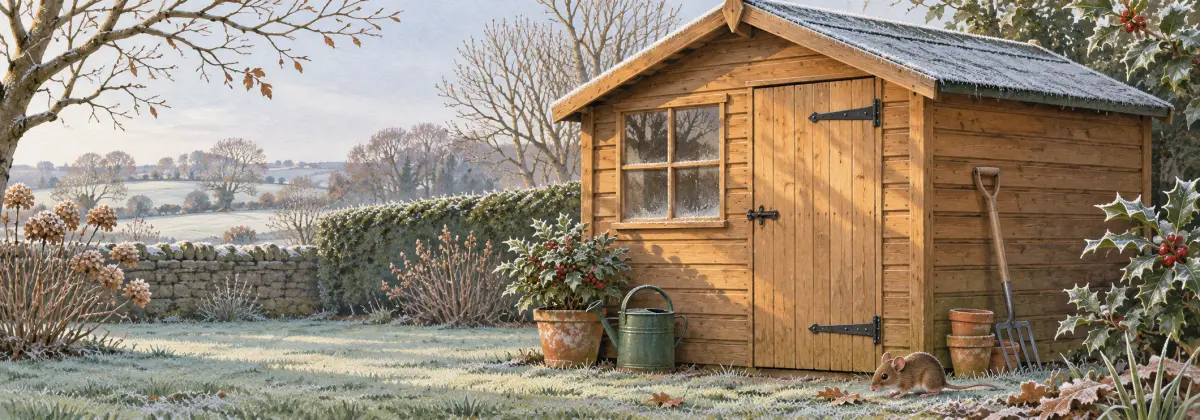
Mice and rats do not need much encouragement to move into a shed. A dry floor, a bag of bird seed and a gap under the door can turn a quiet garden building into a winter shelter. The good news is that you can usually solve the problem in the right order: identify the animal, clean safely, remove food and nesting material, proof the building, then use control only where it is justified.
Seal every opening larger than 5 mm, move food into metal or heavy-duty plastic containers, remove nests with wet cleaning methods, and inspect the shed again after dark. If you find rats under the base, activity in the house or drains, or a large established infestation, call a professional.
Mouse or rat signs
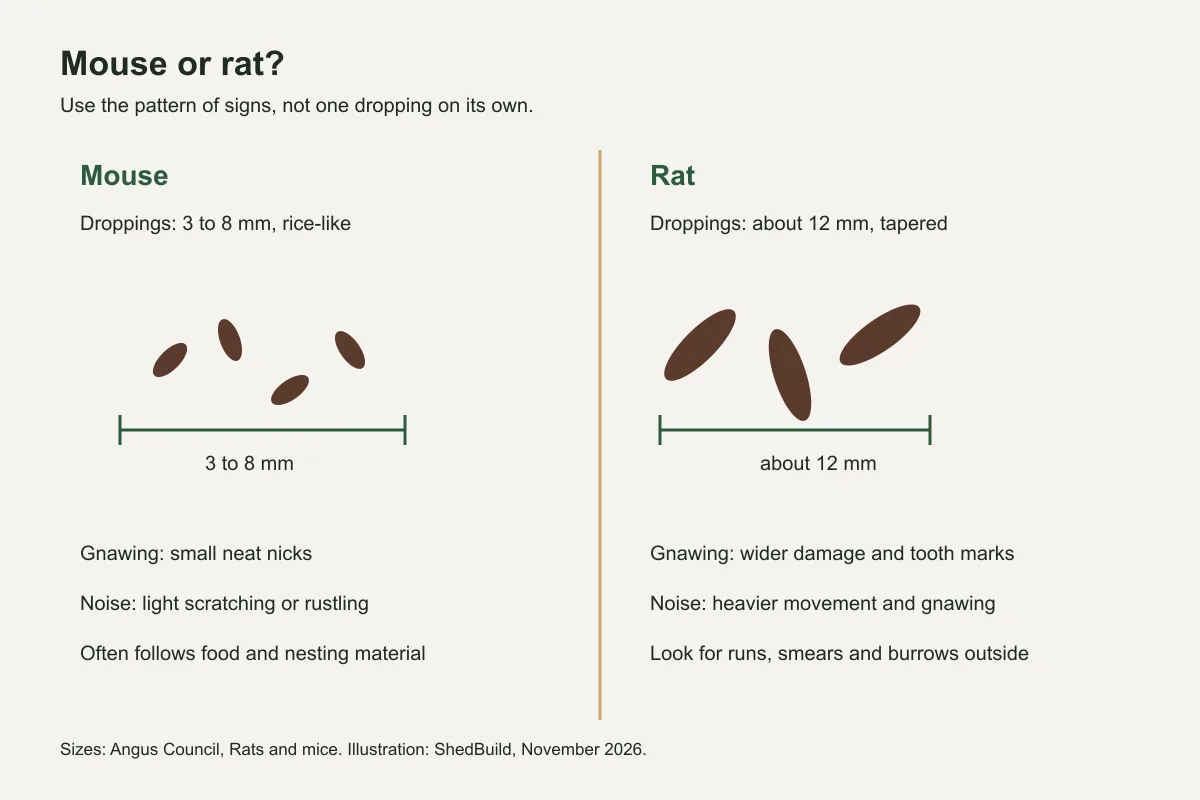
One dropping is not a diagnosis. Check several signs together, and remember that a field mouse may visit a shed without establishing a nest. Angus Council describes mouse droppings as typically 3 to 8 mm and rat droppings as about 12 mm and tapered. Rats are more likely to leave runs through grass, dark smears where their fur brushes a surface, larger gnaw marks and a burrow outside. Both species are nocturnal, gnaw continually and leave a stale urine smell when activity is established.
| Sign | More consistent with a mouse | More consistent with a rat |
|---|---|---|
| Droppings | 3 to 8 mm, rice-like, often scattered near food | About 12 mm, tapered at both ends |
| Gnaw marks | Small neat nicks in packets, wood or soft plastic | Wider tooth marks in wood, containers or cables |
| Runs | Little evidence outside, though mice follow edges indoors | Regular paths through grass, soil or dusty edges |
| Burrows | Unusual around a shed, unless food and cover are close | Round holes under the base, paving edge or compost area |
| Noise | Light scratching and rustling, usually at night | Heavier movement, gnawing or squeaking at night |
| Smell | Musky urine smell when nesting is established | Strong stale urine smell, sometimes with oily smears |
| Nesting | Shredded paper, insulation, fabric or seed husks | Shredded material, often with a route to an outside burrow |
If you see a rat in the shed, take the evidence seriously even if you see only one. Rats travel, so look beyond the building at compost, bins, bird tables, drains and the boundary with the next garden.
Why sheds attract rodents in winter
A shed offers three things rodents need: shelter from cold and wet weather, nesting material and a dependable food smell. The building does not have to be warm. A dry void beneath a timber floor is already better than exposed grass, and stored items create dark cover.
- Food. Bird seed, grass seed, chicken pellets and pet food are all easy wins. A paper sack is not a container once teeth have found it.
- Cover. Cardboard, old cushions, compost bags, tarpaulins and loose insulation make quick nests.
- Water. Leaking gutters, damp corners and spilled water around pots reduce the need to forage elsewhere.
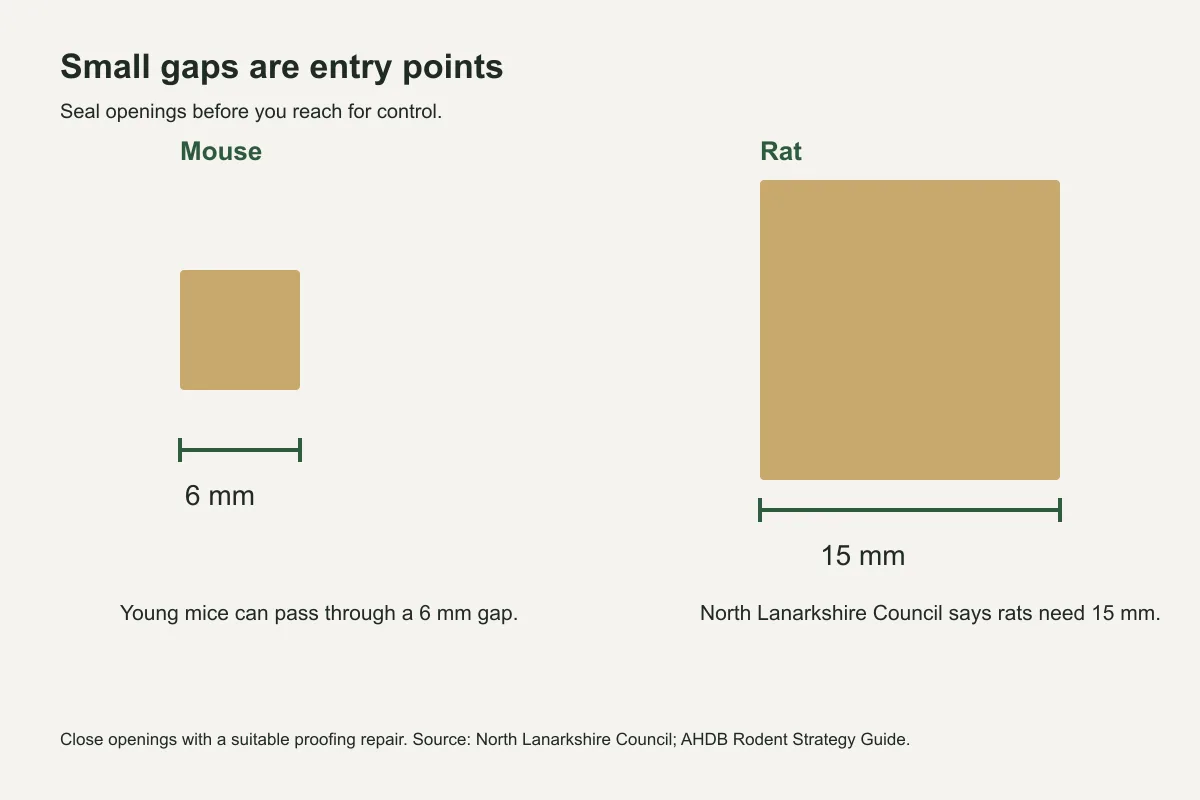
- Access. A door that does not meet its threshold, an open vent or the gap around a cable can be enough. North Lanarkshire Council says rats need only 15 mm and mice 6 mm, while an AHDB guide recommends proofing mouse access points to 5 mm or less.
Autumn is the sensible time to act. Clear fallen fruit, tidy compost, close bins properly and give garden birds only enough seed for the day, leaving as little on the ground as possible. Store seed and pet food away from the shed if you can. If it must stay there, use a lidded metal bin or a sound, rodent-resistant container and keep it raised off the floor.
Clean droppings safely
Rodent urine and droppings can carry infection. NHS says leptospirosis, also called Weil's disease, is spread in the urine of infected animals and can cause anything from mild flu-like symptoms to serious illness. UKHSA advises handwashing, covering cuts, protective clothing and avoiding contact with rodents. The government guidance for cleaning rodent excrement is especially clear: “Do not sweep or vacuum up mouse or rat urine, droppings, or nests.”
Open the shed door and let it air before cleaning. Keep children and pets out. Put on rubber household gloves, cover cuts with waterproof plasters and use a suitable face mask if dust is likely. Do not dry brush, sweep or vacuum. Wet the droppings and nesting material with disinfectant, leave it for the product's stated contact time, then lift it with damp disposable towels. Bag the waste securely, disinfect the surface and wash your hands thoroughly. Clean reusable gloves before removing them.
If you develop a high temperature, headache, muscle aches, vomiting, diarrhoea or red eyes after possible rodent exposure, contact NHS 111 or your GP and mention the exposure. Do not handle a dead rat or mouse with bare hands. If a pet has caught one, ask your vet what to do.
Audit every entry point
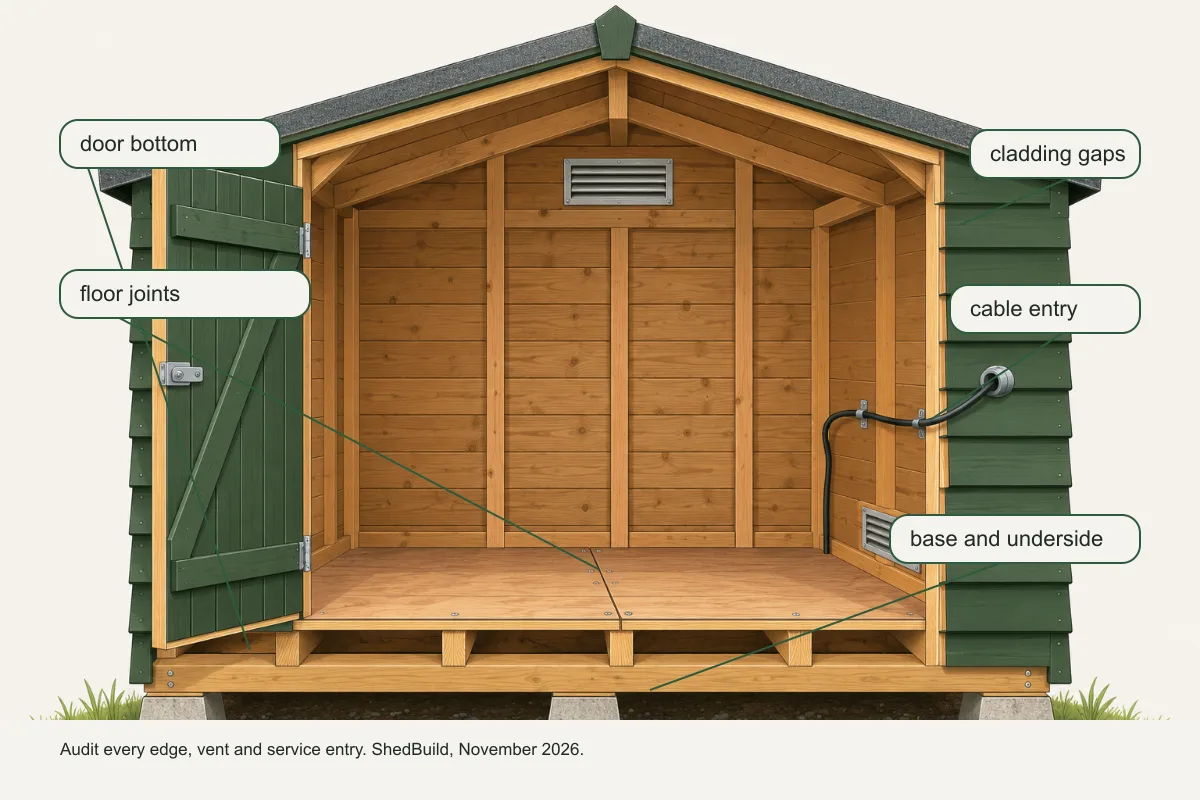
Start outside in daylight, then repeat the check with a torch after dark. Look for a line of light, a draught, droppings, gnawing or a polished track. A shed audit should cover the whole perimeter, not only the place where you found the first dropping.
| Entry point | Typical gap | Fix and materials | Rough cost |
|---|---|---|---|
| Door bottom | 6 to 15 mm at a worn threshold | Metal kick plate, threshold strip and a tight brush seal | £20 to £50, our estimate based on a small DIY repair |
| Floor joints and corners | 5 to 15 mm | Steel wool packed behind a screwed metal strip, not foam alone | £10 to £30, our estimate |
| Cladding gaps | 5 mm or more | Repair timber, metal mesh or a metal-backed patch | £15 to £60, our estimate |
| Cable and pipe entries | 6 mm is enough for mice | Steel wool and exterior-grade sealant around a rigid sleeve | £8 to £25, our estimate |
| Vents | Check grille aperture, not just the frame | Sound metal mesh fixed behind the vent without blocking airflow | £10 to £35, our estimate |
| Base and underside | 15 mm can admit rats | Solid slabs or concrete, then a steel mesh skirt or apron where tunnelling is possible | £80 to £300+, our estimate based on a small shed perimeter |
These costs are planning figures, not quotations. The biggest variable is if you can reach the base without moving the shed. Never block a ventilation opening with a material that can rot or trap water.
Proof the shed and its base
Rodents chew soft materials, so expanding foam, plastic mesh and timber alone are poor final barriers. Use steel wool behind a rigid cover for small irregular gaps, and use metal kick plates where a door edge is being gnawed. A UK government rodent manual specifies 6 mm mesh in a metal frame for mouse screens and describes a 30 cm high 20-gauge metal kick plate with no more than 7 mm clearance at the ground. For vents and larger openings, use galvanised steel mesh fixed so it cannot flex away from the frame, and match the aperture to the animal you need to exclude.
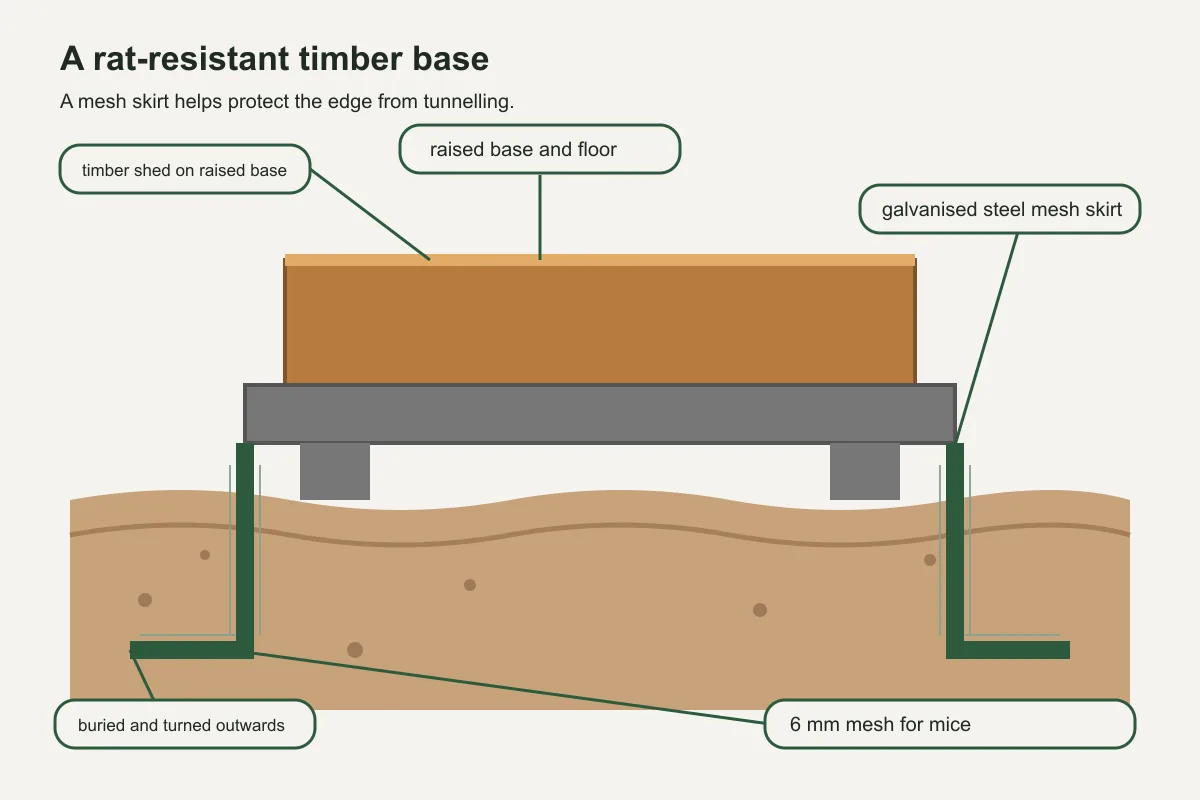
For rats under a timber shed, the durable answer is to remove their route under the building. A slab or concrete base is easier to inspect than bare soil. If the shed must remain raised, fit a steel mesh skirt or apron around the perimeter and bury or turn it out at the edge so a rat cannot simply tunnel under it. Do not seal a live animal inside. If fresh signs continue, control the infestation or take professional advice before closing the final access point.
Our shed foundation guide explains the base options, and the plastic shed bases guide covers lightweight alternatives. For the building above the base, see how to waterproof a shed and the annual shed maintenance checklist.
Control options and the law
Control is not a substitute for removing food and access. It is also not risk-free around children, pets, hedgehogs or birds of prey. GOV.UK says you may use only permitted animals, methods and traps, must follow the product instructions and must protect other animals from traps or poison.
| Method | Legal for homeowners | Risk to pets and wildlife | Effectiveness and notes |
|---|---|---|---|
| Snap traps | Generally yes for rats and mice when the trap is approved and used as directed | High if exposed; use a secure tunnel or box and place it where children and pets cannot reach | Can be effective when placed across a run, with the trigger end against the wall. Check frequently and remove carcasses safely. |
| Live-catch traps | May be lawful, but welfare duties still apply | Stress, dehydration and exposure; non-target animals may be caught | Check very frequently, never leave an animal to suffer, and get advice before deciding what to do with a live catch. Do not release a rat or mouse near another home. |
| Rodenticide | Only products and uses permitted on the label, within CRRU UK stewardship rules | Primary poisoning of pets and wildlife, plus secondary poisoning of predators and scavengers | Use tamper-resistant bait stations exactly as the label says, remove leftover bait and search for carcasses. Keep children and pets away. |
| Glue traps | Not a homeowner option in England from 31 July 2024; Wales also prohibits capturing vertebrates with glue traps | Severe welfare risk and indiscriminate capture | Scotland's ban on use, supply and possession came into force on 1 July 2026. Do not use them. |
In England, the Glue Traps (Offences) Act 2022 makes setting a glue trap for a rodent an offence unless it is under a licence and the terms are followed. Its remaining provisions came into force on 31 July 2024. Wales is covered by the Act's extent and Agriculture (Wales) Act 2023 also makes using a glue trap to capture a vertebrate an offence. Scotland's Wildlife Management and Muirburn Act 2024 now makes it a criminal offence to use, supply or possess a glue trap.
Rodenticide labels matter more than a general internet rule. CRRU UK stewardship distinguishes products for amateur use and professional use, and the label sets the permitted pack size, placement and building use. Do not scatter loose bait in a shed. Use only a labelled bait station, keep an inventory, remove uneaten bait and look for poisoned carcasses. Hedgehogs, owls, foxes, cats and dogs can all be harmed by exposure.
Snap traps are usually the most controllable DIY option for a small shed infestation if you can place them securely. Put them beside a wall or known run, never in an open walkway. Check them at least daily and more often if the shed is warm or a pet could reach it. A live-catch trap demands even closer attention. If you are unsure about species, placement or welfare, use a BPCA member or another qualified pest professional.
When the council or a professional can help
GOV.UK says councils may provide treatment for a fee, but there is no single national price. For current examples, Chelmsford lists £78 for rats from 1 April 2026 to 31 March 2027, including up to five residential visits. Manchester lists £58 for rats and £101 for mice, each for up to three visits. East Devon lists £91.80 for either rats or mice, up to three visits. These are examples, not a promise that your council will offer the same service.
The Prevention of Damage by Pests Act 1949 gives local authorities a duty to keep their district free from rats and mice so far as practicable and powers to require owners or occupiers to take reasonable steps. In practice, your council may offer a paid service, advice or enforcement rather than a free visit. Check its current pest-control page, especially if the source is a drain, neighbouring land or council-owned property.
Call a professional when rats are in the house, loft or drains; you find several active burrows under the shed base; signs continue after food and access are addressed; you hear movement in walls; there is a strong smell or a large nest; or poison would be unsafe because children, pets or wildlife can reach the area. A professional can trace the route, identify the species and coordinate proofing with control.
What not to rely on
Ultrasonic devices, peppermint oil and other scent repellents are not a proofing plan. Evidence for consumer repellents is mixed and any effect may be temporary as animals habituate. A shed with an open 6 mm gap and a sack of seed is still attractive. Spend the money first on a metal container, a door seal, mesh and a better base.
Do not fill a burrow while rats are active, because you may push them into the shed or house. Do not seal every hole before you know whether an animal is inside. Do not leave bird food on the ground overnight, put loose poison in a corner, or use a trap where a hedgehog, cat or child could reach it. Do not dry sweep droppings, and do not assume a clean floor means the outside route has gone.
A simple seasonal prevention calendar
- September and October. Empty old nests and clutter, check the threshold, repair cladding, clean gutters, store seed securely and inspect the base before winter rain.
- November to February. Check for fresh droppings, gnawing, runs and damp smells monthly. Keep food sealed, clear fallen fruit and recheck the door after wet weather.
- Spring. Look under the shed for new burrows and repair any damage caused by frost or movement. Clean vents without blocking them.
- Once a year. Work through the shed maintenance checklist, measure suspicious gaps and record any repairs so the next inspection is quicker.
Your one-week action plan
- Day 1: Photograph droppings, gnaw marks and any burrow. Measure the largest gap and decide whether the signs fit a mouse or rat.
- Day 2: Remove food, cardboard and nesting material. Move seed and pet food into lidded metal or heavy-duty plastic containers.
- Day 3: Air the shed and clean droppings with wet methods, gloves and disinfectant. Keep children and pets away until surfaces are dry.
- Day 4: Audit the door bottom, floor joints, cladding, cable entry, vents and the underside. Mark each gap with tape.
- Day 5: Fit metal-backed repairs, steel wool behind rigid covers, a proper door seal and metal mesh at vents. Do not close a route if a live animal may be inside.
- Day 6: If fresh signs remain, use a secure approved trap or contact your council or a professional. Avoid glue traps and loose poison.
- Day 7: Walk the perimeter after dark, check for new signs and plan the base repair. If there are burrows, house activity or drain evidence, book professional help.
That order matters. Identify first, clean safely, remove the reason to stay, proof the route and only then choose control. A shed that is dry, food-safe and closed to a 5 mm target is a much less appealing winter home.
Summary
Start with evidence and hygiene, not panic. Mouse droppings are usually smaller than rat droppings, but burrows, runs, smell and damage complete the picture. Seal openings to 5 mm or less, use metal where teeth can reach, store food securely and keep control methods away from children and wildlife. If the problem reaches the house, drains or the shed base, bring in a professional.
For the wider building, our waterproofing guide, condensation guide and shed safety guide help keep the space dry and safe.
Frequently asked questions
How small a gap can a mouse get through?
Should I use poison in a shed?
Can I use a glue trap for mice in the UK?
How do I know whether a burrow belongs to a rat?
Will peppermint oil or an ultrasonic device keep rodents out?
Building a new shed?
Design a timber shed to your exact size with our free builder and get a complete materials list, cutting plan and cost estimate.
Open the Shed BuilderReady-made sheds worth a look
Rather buy than build? These sheds come delivered as panels, ready to assemble.
 Shire Value Overlap Apex Shed 8x6
 Yardmaster Emerald Deluxe 65GEYZ Metal Shed 1.86 x 1.25m
 Mercia Value Overlap Pent Shed 10x6
Affiliate links. We may earn a commission at no extra cost to you.